
What Is an Up-and-Down Bet? SSA Singles Unpacked
 Available in US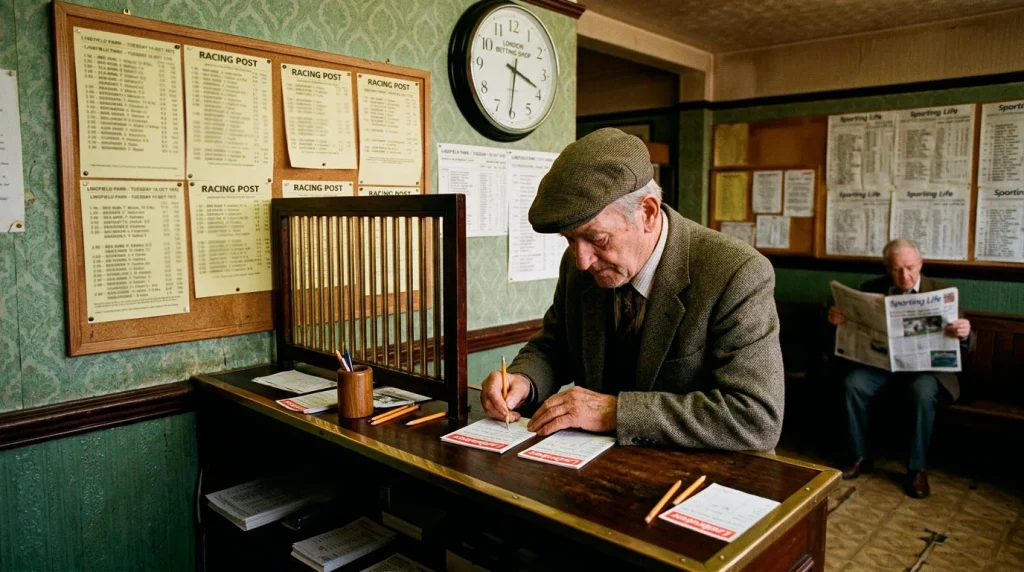
Before it was a line item inside a round robin, the up-and-down bet had a life of its own. It was one of the most popular wagers in British betting shops from the 1960s through the 1990s — a conditional bet where one win funds another, written on a paper slip and settled by hand behind the counter. The formal name is “single stakes about,” abbreviated to SSA. The colloquial name, “up-and-down,” describes the alternating flow of money: up from a winning first leg, down onto a second.
Today, most punters encounter the up-and-down exclusively as the SSA component of a round robin, without knowing it was once a standalone betting product. This article traces the bet’s origins, explains exactly how it settles, and considers its place in a modern betting landscape that has largely moved on from the shop-counter era where it thrived.
What Is an Up-and-Down Bet? SSA Singles Unpacked — More on this topic at horse racing round robin.
History of the Any-to-Come Wager
The any-to-come (ATC) wager predates the legalisation of off-course betting in Britain. Before the Betting and Gaming Act 1960 opened the door to licensed betting shops, punters placed bets through credit accounts, on-course bookmakers, or illegal street bookies. Conditional bets — “if this wins, put the profit on that” — were a natural part of this verbal, trust-based system. The phrase “any to come” meant exactly what it said: if there is any profit to come from the first bet, use it to fund a second.
When betting shops legalised in 1961, the any-to-come bet migrated indoors. Shop staff were trained to settle these wagers manually: check the result of Race 1, calculate the profit, deduct one unit stake for the conditional second bet, place it on Race 2, wait for the result, settle. The process was labour-intensive but intuitive for anyone working behind the counter five days a week.
The up-and-down — a specific form of any-to-come where two selections are paired in both directions — became the standard conditional bet for punters who wanted two linked singles without the cost of a double. It was cheaper than a double (one unit stake instead of two, since only one direction could fire at a time) and offered a different risk profile: partial returns when one selection won and the other lost, rather than the double’s all-or-nothing outcome.
The ecosystem that sustained this bet has contracted sharply. An HM Treasury review documented that land-based betting revenue nearly halved over the past decade, with shop numbers falling from around 9,000 to roughly 6,000. The staff who could settle an up-and-down from memory are retiring. The terminals replacing them do not always offer the bet type.
Yet the economics of the bet remain relevant. Alan Delmonte, Chief Executive of the Horserace Betting Levy Board, noted that February and March 2025 produced bookmaker gross profits well above recent norms, with results at the Cheltenham Festival proving particularly bookmaker-friendly. Major festivals generate the kind of multi-race interest that historically drove up-and-down betting — punters with opinions on several races, looking for a structured way to link them without committing to a full accumulator.
Mechanics: How an Up-and-Down Settles
An up-and-down bet pairs two selections — call them X and Y — and creates two conditional singles running in opposite directions. The bet costs one unit stake. Here is the settlement logic, step by step.
Direction 1: X→Y. If X wins, the profit from X is calculated. One unit stake is deducted from that profit and placed as a single on Y. If Y also wins, you collect the return from Y plus any leftover profit from X (the portion exceeding one unit stake). If Y loses, you retain the leftover profit from X but lose the unit stake placed on Y.
Direction 2: Y→X. The mirror image. If Y wins first, one unit stake from Y’s profit goes onto X. Same settlement logic in reverse.
Crucially, both directions exist within the same bet. You pay one unit stake and get two conditional pathways. This is what distinguishes an up-and-down from simply placing two separate conditional bets: the cost is halved because only one direction can trigger the second leg in any given pair. If both X and Y win, both directions fire, and you collect from both pathways. If only one wins, only the pathway originating from the winner activates.
Let us run the numbers. X is priced at 3/1 (decimal 4.00), Y at 2/1 (decimal 3.00). Unit stake: £1.
Both win: X→Y: Profit from X = £3. Deduct £1, place on Y. Y wins, returns £3. Leftover from X: £2. Pathway total: £5. Y→X: Profit from Y = £2. Deduct £1, place on X. X wins, returns £4. Leftover from Y: £1. Pathway total: £5. Combined return: £10 from a £1 stake. Profit: £9.
Only X wins: X→Y fires: Profit from X = £3. Deduct £1 for Y. Y loses. Leftover: £2. Y→X does not fire: Y lost, no trigger. Net return: £2 from a £1 stake. Profit: £1.
Neither wins: No triggers. Loss: £1.
The up-and-down always costs less than placing two singles separately (which would cost £2). It also returns less when both win, because each pathway’s second leg is funded from profit rather than fresh stake. The trade-off is cost efficiency at the expense of maximum return — a defining characteristic of conditional betting.
Up-and-Down Beyond Round Robin
The up-and-down bet does not require a round robin to exist. You can place a standalone up-and-down on any two selections at bookmakers that support the bet type — though finding one that does is increasingly difficult online.
In physical betting shops, the up-and-down remains available over the counter. You write your two selections on a slip, mark it “SSA” or “up-and-down,” and hand it to the cashier. The Gambling Commission reports that 5,825 betting shops remained open in Britain as of March 2025, down 36 percent over the past decade. Each closing shop takes with it a counter where up-and-down bets were once routine.
Online, the picture is thinner. Most digital bet slips do not offer SSA or up-and-down as a standalone bet type. The conditional logic is embedded within the round robin product but not exposed as an independent option. A punter who wants a single up-and-down on two horses — without the rest of the round robin’s doubles and treble — has limited choices: phone betting, over-the-counter placement, or manually replicating the conditional by watching the first race and placing the second single if the first leg wins.
The up-and-down’s niche status does not diminish its utility. For punters who want linked exposure to two selections at half the cost of two singles, the mechanics are sound. The problem is access, not design. As betting continues its shift from shop to screen, the up-and-down’s future depends on whether any operator sees enough demand to build it as a standalone digital product — or whether it will survive only as an unnamed passenger inside the round robin.
Summary
The up-and-down bet is a conditional wager where one win funds another. It predates the round robin as a standalone product, born in the any-to-come culture of British betting shops and formalised as “single stakes about.” Two selections, two directions, one unit stake. The maths is transparent, the cost is low, and the partial-return profile offers something that neither a double nor two separate singles can replicate.
Today it lives mostly inside the round robin, where six up-and-down pairs account for 60 percent of the total outlay. Understanding the bet on its own terms — as a historical product with distinct mechanics — makes the round robin’s structure less mysterious and its cost more logical.
See also Round Robin for Cheltenham Festival 2026.
