
Union Jack Round Robin: 9 Selections, 80 Bets Explained
 Available in US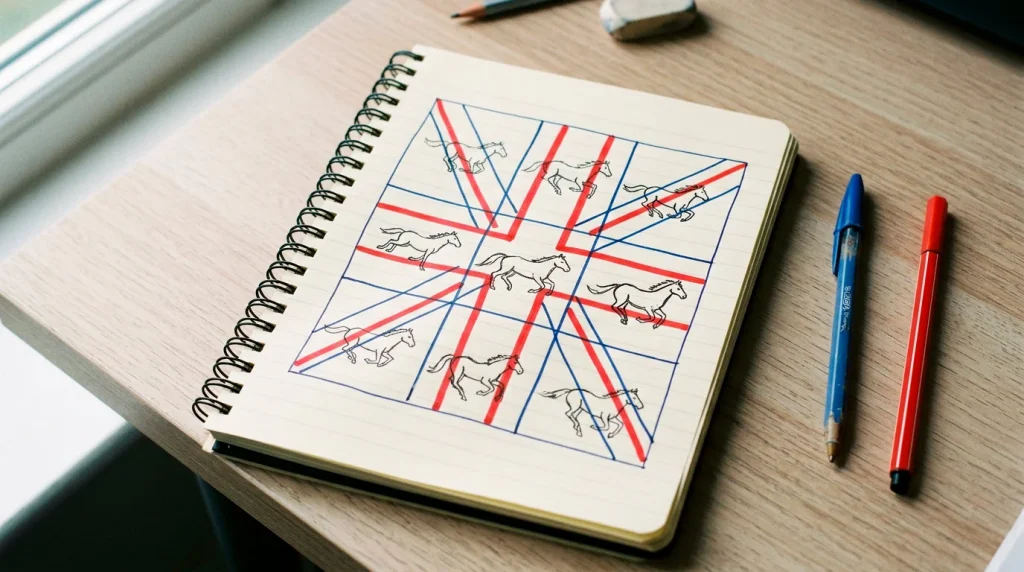
If the standard round robin is ten bets from three selections, the Union Jack Round Robin is its bigger, wilder cousin: eighty bets from nine selections, arranged in a 3×3 grid and linked by rows, columns, and diagonals. The name references the pattern of the Union Jack flag, where the lines crossing the grid mirror the flag’s cross-and-saltire design. It is one of the most complex wagers available on a standard bookmaker’s bet slip, and whether that complexity is ever justified is a question worth examining honestly.
Union Jack Round Robin — More on this topic at horse racing round robin.
The 3×3 Grid Structure
The Union Jack Round Robin begins with nine selections arranged in a grid of three rows and three columns:
| A1 | A2 | A3 |
| B1 | B2 | B3 |
| C1 | C2 | C3 |
The bet creates a round robin (ten bets) on every line that crosses the grid in the pattern of the Union Jack flag. Those lines are: three rows (A1-A2-A3, B1-B2-B3, C1-C2-C3), three columns (A1-B1-C1, A2-B2-C2, A3-B3-C3), and two diagonals (A1-B2-C3, A3-B2-C1). That gives eight lines, each generating a ten-bet round robin. Eight times ten equals eighty bets.
Each individual round robin within the Union Jack follows the same mechanics as a standard three-selection round robin: three doubles, one treble, and six SSA singles per line. The difference is scale. Where a standard round robin manages three selections across ten bets, the Union Jack manages nine selections across eighty bets, with overlapping lines sharing selections. The centre square (B2) is particularly significant — it appears in one row, one column, and both diagonals, meaning it features in four of the eight round robins. If B2 loses, four entire round robins within the Union Jack are compromised.
The grid must be filled with selections from nine different races. You cannot place two horses in the same race into the grid, because each round robin line requires its three members to come from separate events. For a race meeting with nine or more races on the card — a typical festival day — filling the grid is feasible. For a quieter afternoon with six races, you would need to pull selections from multiple meetings.
The positioning of selections within the grid matters more than most punters realise. Corner positions (A1, A3, C1, C3) appear in one row, one column, and one diagonal — three lines each. Edge positions (A2, B1, B3, C2) appear in one row and one column — two lines each. The centre position (B2) appears in one row, one column, and both diagonals — four lines. This means B2 is the most consequential pick: a winning B2 contributes to four round robins, while a losing B2 damages four. Place your most confident selection in the centre and your least confident picks on the edges to minimise the downside of a single failure.
Cost and Realistic Returns
At a £1 unit stake, the Union Jack Round Robin costs £80. Each of the eighty component bets — twenty-four doubles, eight trebles, and forty-eight SSA singles — carries its own margin. Philip Newall’s research established that bookmaker margins on complex multi-leg constructions can reach dramatically higher levels than on simple bets: during the 2014 World Cup, expected loss margins averaged 5 percent on match-winner bets but climbed to 48 percent on first-goalscorer bets (Judgment and Decision Making, 2015). As Newall concluded, «complex bets generally carry odds that lead to a greater expected loss margin for the bettor». An eighty-bet structure gives the overround eighty separate surfaces to compound across.
The returns can be substantial if multiple lines produce two or three winners. But the probability of all nine selections winning — which would fire all eight trebles and all twenty-four doubles — is vanishingly small. At typical mid-range odds, the probability of nine independent winners sits below 0.01 percent. More realistically, you might see four to six winners, producing returns on some lines while others collapse. The variability of outcomes is extreme: two Union Jack Round Robins placed on consecutive Saturdays can produce wildly different results even at similar overall strike rates, because the pattern of which lines survive depends on which specific grid positions win.
A £1 each-way Union Jack Round Robin costs £160. At that price, you are committing the equivalent of a small bankroll to a single bet slip. Even at 50p per unit, the total outlay is £40 (win only) or £80 (each-way) — serious money for a recreational punter. The minimum sensible approach, if you want to try the format, is to use the smallest unit stake your bookmaker allows and treat the entire outlay as entertainment expenditure you can afford to lose in full.
Is the Union Jack Round Robin Ever Justified?
The honest answer is: very rarely, and only under specific conditions.
The Union Jack makes structural sense when you have strong opinions on nine races at a major festival — Cheltenham, for instance, where the programme provides enough depth to fill the grid with informed selections. The grid’s overlapping architecture means a good day (five or six winners) can produce returns across multiple lines, amplifying the effect of a strong card read.
But the cost is prohibitive for most bankrolls, and the margin drag is savage. Research by Newall and colleagues in the Journal of Behavioral Addictions found that on high-complexity bet types, bookmaker margins can reach 74.6 percent on the most exotic constructions. An eighty-bet Union Jack, while not as extreme as the request-a-bet products studied in that paper, occupies the high end of the complexity spectrum. The aggregate expected loss as a percentage of stake is meaningfully worse than on a standard three-selection round robin.
The Union Jack is also cognitively demanding. Tracking nine selections across eight interlocking round robins during a live race meeting requires either a spreadsheet or a tolerance for uncertainty about your current position. Most punters who place a Union Jack discover mid-afternoon that they have lost track of which lines are alive and which are dead. The bet becomes an act of faith rather than an act of analysis — the opposite of what structured betting should achieve.
If the idea appeals to you, consider this compromise: place two or three standard round robins on the lines you feel strongest about rather than committing to the full Union Jack. You get the structural benefit of the round robin format applied to your best selections, at a fraction of the cost, with full clarity about what is at stake on each line. Three standard round robins cost £30 at £1 per unit — less than half the Union Jack’s £80 — and focus your exposure on the horses you actually believe in, rather than diluting your conviction across nine selections to fill a grid pattern.
Summary
The Union Jack Round Robin is the round robin’s bigger, wilder cousin: nine selections, eighty bets, £80 at a £1 unit stake. It arranges selections in a 3×3 grid and runs a standard round robin on every row, column, and diagonal — eight lines, each with its own ten-bet structure.
The cost is high, the margin compounding is severe, and the cognitive load during a live meeting is substantial. For most punters, the standard three-selection round robin provides the structural benefits of the format without the sprawl. If you want to scale up, add a second round robin on a different set of three selections rather than graduating to the Union Jack. The complexity is rarely worth the price of admission.
See also Round Robin vs Accumulator.
