
History of the Round Robin Bet in British Racing
 Available in US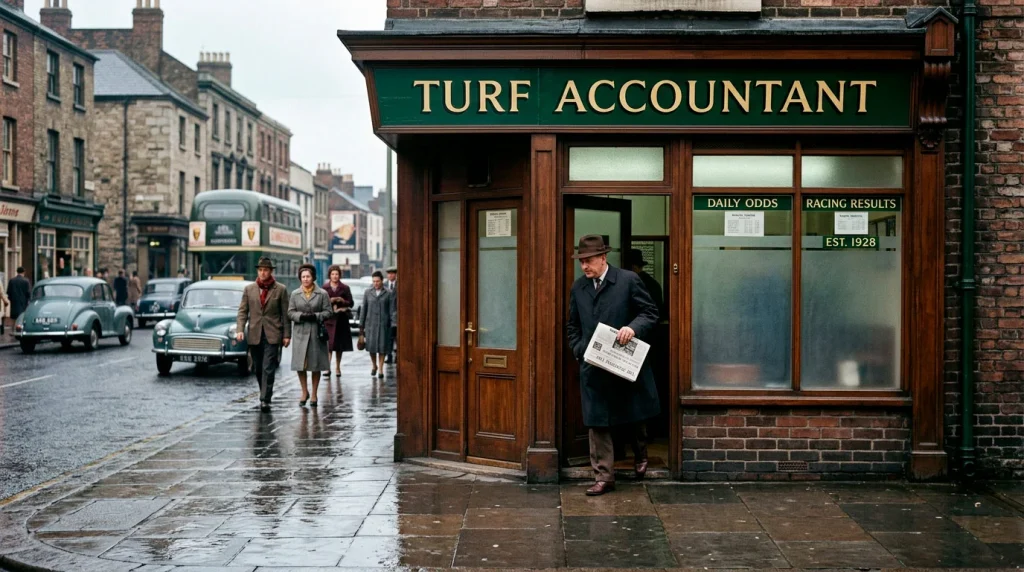
The round robin was not designed in a boardroom or coded by a software team. It evolved on the counters of British betting shops, written on paper slips by punters who wanted more structure than a treble and more coverage than a Trixie. Its ten-bet architecture — three doubles, one treble, six conditional singles — is a product of the high-street era, shaped by the habits of an industry that did most of its business face to face. Understanding where the bet came from explains why it looks the way it does, why some bookmakers still carry it, and why others have quietly dropped it from their digital platforms. From pencil slips to touchscreens — this is the story.
History of the Round Robin Bet in British Racing — More on this topic at horse racing round robin.
The High-Street Era
Legal off-course betting in Britain began with the Betting and Gaming Act 1960, which permitted licensed betting shops to open from May 1961. Within a decade, thousands of shops lined the high streets of towns and cities across the country. By the late 1970s, the estate had peaked at more than 15,000 premises, and the betting shop had become a fixture of British retail life — as commonplace as the newsagent or the chip shop.
Inside those shops, the menu of bets was richer than anything the modern online punter would recognise. Paper slips and pencils were the interface. Punters wrote their selections, marked the bet type, and handed the slip to a cashier who processed it by hand. The round robin was one of many combination bets on offer: Trixies, Patents, Yankees, Lucky 15s, Heinz bets, and more exotic constructions like Flag bets and Alphabet bets. Each had its own constituency of regular users who understood the mechanics from years of Saturday-afternoon practice.
The round robin occupied a specific niche. It appealed to punters who wanted the upside of a Trixie’s doubles and treble but also wanted coverage when only one selection won. The six SSA (single stakes about) pairs provided that coverage through a conditional mechanism that was intuitive to shop staff: if the first horse wins, put a pound on the second. The language — “up-and-down,” “any to come” — was part of the shop’s oral culture, passed from experienced cashiers to newcomers and from regulars to first-timers.
Horse racing was the dominant product. Football betting existed, but the pools and fixed-odds coupons were separate operations. The betting shop was, first and foremost, a venue for racing, and the combination bets on its menu were designed for the sport’s multi-race card format. A Saturday afternoon with six or seven races gave punters the raw material for round robins, Yankees, and other multi-selection structures. The racing industry recognised its dependence on these bets and on the shops that hosted them. As Brant Dunshea, the BHA’s Acting Chief Executive, put it when the government confirmed a favourable tax settlement for racing in November 2025, the sport is a unique national asset — culturally, socially, and economically. That status was built, in large part, through the betting shops that connected the racecourse to the high street.
The financial scale was considerable. An HM Treasury review recorded that land-based betting generated £3.3 billion in gross gambling yield as recently as 2015-16. The shops employed tens of thousands of staff, contributed to local economies, and served as the primary interface between the public and the sport of horse racing.
Decline of the Betting Shop and Round Robin
The contraction began in the 2000s and accelerated through the 2010s. Multiple forces converged: the rise of online betting, the 2005 Gambling Act that liberalised remote operators, the introduction and subsequent reduction of fixed-odds betting terminal (FOBT) stakes, and a gradual shift in consumer behaviour away from high-street retail towards digital convenience.
The numbers tell the story plainly. The Gambling Commission counted 5,825 licensed betting premises in Britain as of March 2025 — a reduction of 36 percent over the previous decade. Land-based gross gambling yield had fallen from £3.3 billion in 2015-16 to £2.5 billion by 2023-24, according to the same HM Treasury review that documented the shops’ peak. Every closing shop took with it a counter where round robins were routine and a staff member who could settle one without consulting a manual.
The round robin’s decline tracked the shops’ decline. As the industry moved online, the bet types that migrated most successfully were the simplest: singles, accumulators, request-a-bet specials. These could be built into digital interfaces with minimal settlement complexity. The round robin, with its six conditional SSA pairs, required a different kind of logic — one that online platforms were not always willing to build.
Some operators made the investment. Betfred, William Hill, Paddy Power, BoyleSports, and Ladbrokes all carried round robin onto their websites and apps, drawing on the legacy settlement systems they had built for their shop networks. Others — most notably bet365, which grew as an online-first operator without a large shop estate — chose not to include it. The round robin became a litmus test for a bookmaker’s high-street heritage: if the company had shops in the 1990s, it probably offered round robin online; if it did not, it probably did not.
Digital Limbo: Why Online Lags Behind
The round robin exists in a peculiar state today. It is available online at several major bookmakers, but it is not promoted, not featured in marketing campaigns, and not explained in the educational content that most operators publish for new customers. It sits on the bet slip as an option, visible only to those who already know to look for it.
This digital limbo has several causes. First, demand is modest. The round robin’s audience is older and more experienced than the typical online punter, and they represent a small fraction of the customer base. Second, the SSA component is hard to explain in the compressed format of a mobile app tooltip. Third, the bet’s ten-component settlement creates customer service inquiries — punters who do not understand why their round robin returned money when only one horse won, or why the return is different from what they expected. Each inquiry costs the operator time and money.
Self-service betting terminals have partially filled the gap. The touchscreen interface in betting shops supports round robin placement in a way that feels closer to the old counter experience than a phone app does. The bettor selects horses, chooses “Round Robin” from a menu, and the terminal handles the rest. For punters who miss the shop-counter days but still want the convenience of a screen, the SSBT is the closest available compromise.
Whether the round robin will eventually disappear from digital platforms or experience a revival is impossible to predict. Its survival so far owes more to inertia than to active promotion — legacy systems carrying a legacy bet type forward without anyone deciding to remove it. But as long as horse racing runs multi-race cards and punters want structured coverage across three selections, the architecture remains sound. The question is not whether the round robin works — it demonstrably does — but whether enough people know it exists to justify keeping the lights on.
Summary
The round robin was born in the betting shops of 1960s and 1970s Britain, where paper slips, pencil stubs, and experienced cashiers created a menu of combination bets tailored to multi-race cards. It thrived for decades as part of the high-street ecosystem. When that ecosystem contracted — shops closing, staff departing, punters migrating online — the round robin lost its natural habitat.
From pencil slips to touchscreens, the bet has survived by clinging to the platforms of bookmakers with high-street roots. Its future depends on whether those platforms continue to support it and whether a new generation of punters discovers that the ten-bet structure their grandparents used still works as well as it ever did.
See also Overround and Round Robin.
