
Expected Value of a Round Robin Bet: The Maths Explained
 Available in US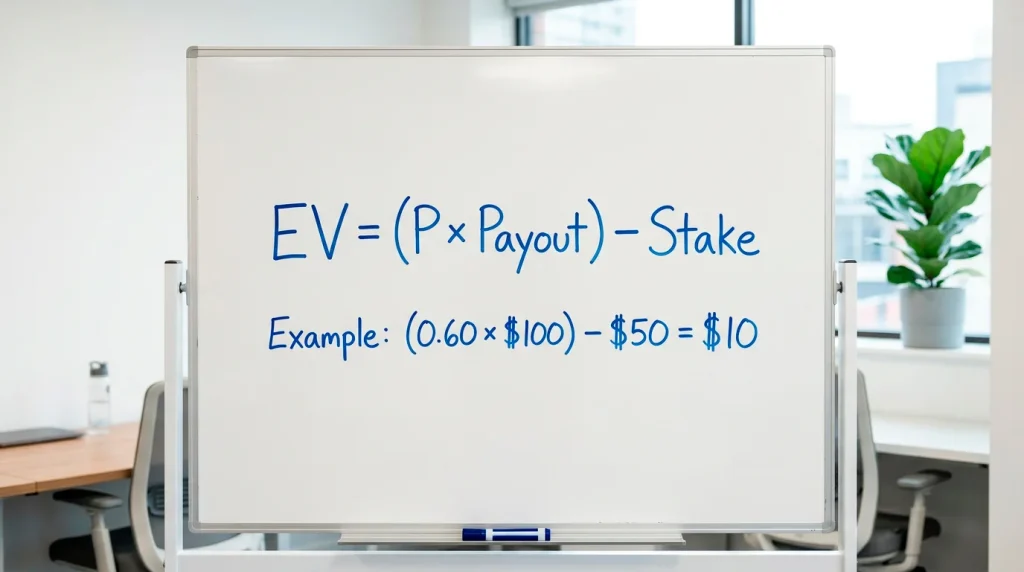
Expected value is the number that tells you what a bet is really worth — not on any given Saturday, but across thousands of repetitions. For a round robin, that number is almost always negative. The question is how negative, and whether the structure of the bet changes the EV picture compared with simpler alternatives. This article derives the EV formula for each component type — doubles, treble, and SSA singles — then aggregates them into a single figure for the full ten-bet package. What the numbers actually say is rarely what punters want to hear, but it is always worth knowing.
Expected Value of a Round Robin Bet — More on this topic at horse racing round robin.
EV Formula for Doubles
Expected value for any bet is calculated as: EV = (Probability of winning × Net profit if win) – (Probability of losing × Stake lost if lose).
For a double combining selections A and B, both must win. If we denote the true probability of A winning as p_A and B winning as p_B, and the decimal odds as D_A and D_B, the formula becomes:
EV_double = (p_A × p_B) × (D_A × D_B × Stake – Stake) – (1 – p_A × p_B) × Stake
Simplify: EV_double = Stake × [(p_A × p_B × D_A × D_B) – 1]
The expression inside the brackets is the crux. If the product of the true probabilities and the decimal odds exceeds 1, the double has positive EV. If it falls below 1, the EV is negative. In practice, bookmaker odds are set so that the implied probabilities (1/D_A and 1/D_B) exceed the true probabilities. This means D_A × D_B is smaller than it would be at “fair” odds, and the product p_A × p_B × D_A × D_B almost always lands below 1.
Philip Newall’s research demonstrated that bookmaker margins on complex wagers are substantially higher than on simple bets — with margins on straightforward markets averaging around 5 percent but climbing towards 48 percent on exotic constructions. As Newall, a gambling researcher at the University of Bristol, concluded: «Empirical evidence shows that complex bets generally carry odds that lead to a greater expected loss margin for the bettor… For the 2014 World Cup, bettor expected loss margins averaged 5% for match winner bets, 28% for scoreline bets, and 48% for first goalscorer bets» (Newall, 2015, Judgment and Decision Making, Vol. 10, No. 3). For a double, the margin on each leg compounds multiplicatively. If each leg carries a 5 percent implied-probability inflation, the double’s effective margin is closer to 10 percent. At a 10 percent margin, the EV of a £1 double is approximately –£0.10. Not catastrophic, but not neutral either.
A three-selection round robin contains three doubles. Their combined EV is the sum of three individual double EVs, each calculated from the specific odds and probabilities of the two selections involved. If all three doubles have roughly similar EV, the total doubles EV is approximately three times the single-double figure.
EV Formula for Treble and SSA
The treble follows the same logic as the double but with three legs:
EV_treble = Stake × [(p_A × p_B × p_C × D_A × D_B × D_C) – 1]
The margin compounds across three legs instead of two, making the treble’s EV more negative per pound staked than any individual double. If each leg adds 5 percent margin drag, the treble’s effective margin approaches 15 percent, yielding an EV of approximately –£0.15 per £1 staked.
SSA singles are more complex because they involve conditional execution. For an SSA pair A→B, the EV must account for three scenarios: A loses (probability 1 – p_A, loss = stake); A wins but B loses (probability p_A × (1 – p_B), return = leftover profit from A minus the second-leg stake); and both win (probability p_A × p_B, return = leftover profit from A plus return from B).
EV_SSA(A→B) = Stake × [p_A × (D_A – 1 – 1) + p_A × p_B × D_B – 1]
This simplifies to: EV_SSA(A→B) = Stake × [p_A × (D_A – 2) + p_A × p_B × D_B – 1]
The conditional structure means the SSA’s EV is partly shielded by the first-leg probability: if A is likely to lose, the second leg never fires and the maximum loss is capped at one unit stake. But when the second leg does fire, it passes through the bookmaker’s margin again. Research by Hegarty and Whelan, published in Applied Economics in 2025, found that standard overround calculations understate real bettor losses by 20 to 40 percent — a gap that widens on multi-leg structures where each leg’s margin feeds into the next.
Six SSA pairs exist in a three-selection round robin, each with its own EV derived from the directional pairing of odds and probabilities. The aggregate SSA EV is the sum of all six.
Aggregate EV of the 10-Bet Package
The total EV of a round robin is simply the sum of its parts:
EV_total = EV_double(AB) + EV_double(AC) + EV_double(BC) + EV_treble(ABC) + Σ EV_SSA(all 6 pairs)
In a concrete example — three selections at 3/1, 5/2, and 4/1, assuming the bookmaker inflates implied probabilities by 5 percent per leg — the aggregate EV of a £1 unit stake (£10 total outlay) round robin lands in the range of –£0.80 to –£1.20. That means for every £10 you stake on round robins at these odds over the long run, you can expect to lose roughly £1 on average. The actual figure varies with the specific odds, the number of runners in each race, and the bookmaker’s margin structure.
Compared with three separate £1 singles on the same horses (total outlay £3), the round robin’s aggregate EV is more negative both in absolute terms and as a percentage of stake. Three singles at 5 percent margin lose approximately £0.15. The round robin’s ten components, with compounding margins, lose six to eight times as much from a stake that is only three times larger. The extra coverage — doubles, treble, SSA — comes at a measurable EV cost.
This does not invalidate the round robin as a product. EV is a long-run concept, and most punters place round robins infrequently — a few times per season at most. In small samples, variance dominates, and individual results can be highly positive. The EV calculation tells you what to expect if you made this bet your default approach over years. For an occasional bet at a festival, the EV drag is a cost of entertainment, not a financial death sentence.
One way to improve the aggregate EV — or at least to slow its decline — is to seek best-odds-guaranteed (BOG) promotions. If a selection drifts after you take a price and the bookmaker pays at the higher starting price, the effective odds on every component involving that selection improve. BOG does not turn a negative-EV bet positive, but it narrows the gap. Similarly, shopping across bookmakers for the best available price on each selection before committing to a round robin reduces the margin baked into each leg. Small improvements compound across ten components just as margins do.
Summary
Every component of a round robin carries negative expected value under standard bookmaker pricing. Doubles compound the margin across two legs, the treble across three, and SSA pairs pass through the margin twice via their conditional trigger. The aggregate EV of a £10 round robin at typical mid-range odds falls roughly –£0.80 to –£1.20 — a meaningful but not ruinous drag.
What the numbers actually say is that a round robin is a more expensive way to bet on three horses than singles, doubles, or a Trixie. The structural protection it offers comes at a quantifiable EV premium. Whether that premium is worth paying depends on how often you place the bet and what you value beyond the numbers.
See also Round Robin Scenarios.
