
How Much Does a £1 Round Robin Cost? Full Pricing Breakdown
The best sites for betting on greyhound racing
Loading...
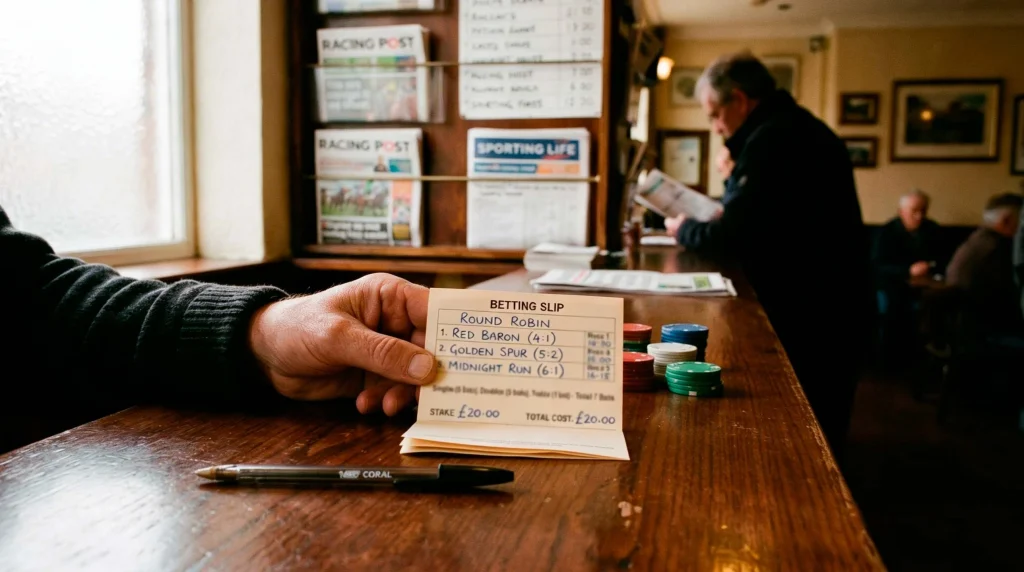
A £1 round robin costs £10. That is the short answer, and if you are in a hurry it is all you need. But the number catches people off guard, because the bet slip says “£1 unit stake” and the brain reads “£1 total outlay.” It is not. A round robin on three selections contains ten separate bets — three doubles, one treble, and six single-stakes-about singles — each charged at the unit stake you enter. Multiply one by ten and you get the real price of admission.
The confusion deepens with each-way round robins, where the bill doubles again to £20 from a £1 unit stake. Understanding exactly where each pound goes is the difference between a controlled bet and an accidental overspend. This guide breaks the cost down component by component, scales it across common stakes from 50p to £10, and sets the round robin’s price tag against the cheaper Trixie and the slightly pricier Patent.
Cost Table by Unit Stake
Every round robin is assembled from exactly three types of component: doubles, a treble, and single-stakes-about (SSA) pairs. Each component is a standalone wager, and each one costs one unit stake. Here is how the arithmetic looks at a £1 level.
The three doubles account for £3 of your outlay. Double one pairs Selection A with Selection B. Double two pairs A with C. Double three pairs B with C. Each double requires both legs to win for a return, but each double is priced individually at your unit stake.
The treble is a single bet combining all three selections. It costs £1. If all three win, the treble delivers the highest individual payout of any component; if even one loses, it returns nothing.
The six SSA singles are where newcomers lose track. An SSA pair links two selections conditionally: if the first wins, a single bet at your unit stake is placed on the second, and vice versa. With three selections, there are six directional pairs — A→B, B→A, A→C, C→A, B→C, and C→B. Each pair costs £1, totalling £6.
Add those up: £3 (doubles) + £1 (treble) + £6 (SSA) = £10. The phrase to remember is straightforward: £1 stake, £10 bill.
Scale the unit stake and the multiplier holds constant. At 50p per unit, the total outlay is £5. At £2 it is £20. At £5 it is £50. At £10 it is £100. The ratio never changes because the number of component bets — ten — is fixed for any three-selection round robin.
| Unit Stake | Doubles (×3) | Treble (×1) | SSA (×6) | Total Outlay |
|---|---|---|---|---|
| £0.50 | £1.50 | £0.50 | £3.00 | £5.00 |
| £1 | £3.00 | £1.00 | £6.00 | £10.00 |
| £2 | £6.00 | £2.00 | £12.00 | £20.00 |
| £5 | £15.00 | £5.00 | £30.00 | £50.00 |
| £10 | £30.00 | £10.00 | £60.00 | £100.00 |
One detail worth noting: more than 80 percent of Grand National bets are placed at a stake of £5 or less, according to Entain data reported by SBC News. At a £5 unit stake a round robin costs £50 — a significant step up from a single fiver on a horse’s nose. If you fall into that casual-staking bracket, a £1 or even 50p unit round robin keeps the total closer to what you probably intended to spend.
Each-Way: Why It Doubles the Bill
An each-way bet is really two bets in one: a win part and a place part, both at the stated unit stake. When you tick the each-way box on a round robin, every one of those ten components splits into two. Ten bets become twenty. A £1 each-way round robin therefore costs £20, not £10.
The place part pays at a fraction of the win odds — typically one-fifth for handicaps with sixteen or more runners, one-quarter for most other races, and one-fifth again in large-field National Hunt events. The terms vary by race type and field size, and bookmakers can adjust them for specific meetings. The point for pricing purposes is that those place terms do not change your total outlay. Whether a race offers quarter-the-odds or fifth-the-odds places, you still pay £1 per component twice.
Why does this matter? Because the each-way round robin’s higher cost is not matched by a proportional increase in potential returns. The place portion of a double, for example, only pays out at fractional odds compounded across two legs, which produces a modest return even when both horses place. The treble’s place part compounds three sets of fractional odds, making the payout relatively slim unless the original win odds were generous. The SSA pairs behave similarly: the conditional trigger still fires, but the second leg’s stake is funded from the place return of the first, which may be less than the original unit stake.
None of this makes each-way round robins inherently bad — they offer a genuine safety net when your selections finish in the frame without winning. But you should walk in knowing that ticking that box exactly doubles the bill. For a £5 each-way round robin, the cost is £100. Budget accordingly.
Comparing Round Robin Cost to Trixie and Patent
A round robin is not the only way to combine three selections. The Trixie and the Patent cover similar ground at different price points, and knowing the cost difference helps you decide which structure fits your budget.
A Trixie contains four bets: three doubles and one treble. It costs £4 at a £1 unit stake. There are no SSA singles, which means no conditional safety net if only one selection wins. A Trixie returns nothing unless at least two of your three picks come in.
A Patent contains seven bets: three singles, three doubles, and one treble. It costs £7 at a £1 unit stake. The three outright singles mean a Patent can return something even with just one winner, though that return will almost certainly be less than the £7 you staked.
The round robin sits above both at £10, buying you the six SSA pairs that neither the Trixie nor the Patent includes. Those conditional singles are the round robin’s distinguishing feature and its main cost driver. Whether they justify the premium depends on the odds profile of your selections and how much you value partial-win protection.
| Bet Type | Components | Cost at £1 | Minimum Winners for Return |
|---|---|---|---|
| Trixie | 3 doubles + 1 treble | £4 | 2 |
| Patent | 3 singles + 3 doubles + 1 treble | £7 | 1 |
| Round Robin | 3 doubles + 1 treble + 6 SSA | £10 | 1 (via SSA) |
Academic research underscores why cost awareness matters for combination bets. Philip Newall’s 2015 study in Judgment and Decision Making found that bookmaker margins on complex wagers can reach 48%, compared with roughly 5% on simple match-result bets. The more components a bet has, the more opportunities the margin has to compound. A round robin’s ten components give the overround ten bites at your bankroll, which is why understanding the upfront cost is only half the equation — understanding the embedded cost is the other half.
Summary
The maths behind round robin pricing is simple once you see it: unit stake multiplied by ten. A £1 round robin costs £10, always. An each-way version doubles that to £20. A Trixie costs £4, a Patent £7 — both cheaper, both with fewer safety nets.
Before placing the bet, run the multiplication in your head. If the total outlay feels uncomfortable, lower the unit stake rather than hoping the returns will compensate. A 50p round robin at £5 total is a perfectly legitimate bet, and one that keeps your afternoon’s entertainment within a range you can forget about by the time the last race is run. Cost clarity is not glamorous, but it is the foundation every sensible round robin is built on.