
Round Robin Bet Explained: How 10 Bets Work Together
The best sites for betting on greyhound racing
Loading...
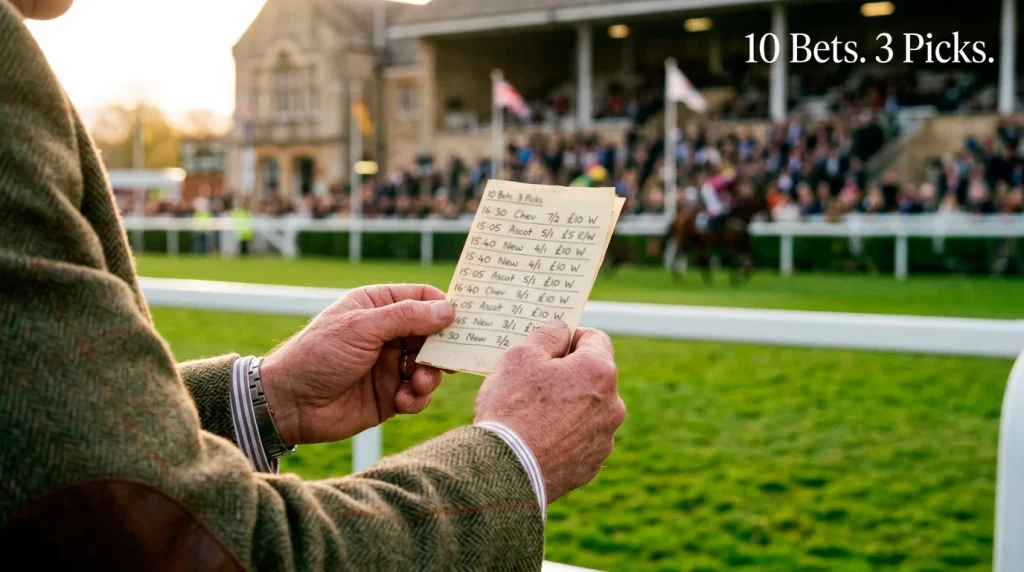
A round robin is not a single bet. It is ten bets from three picks, bundled into one slip and settled independently. Three doubles, one treble, and six single-stakes-about wagers — that is the full inventory. Most punters who tick the round robin box on a betting slip have a rough sense that it offers protection when one selection loses. Fewer can explain exactly why, or trace the money through each component to see where the returns actually come from.
That gap between intuition and understanding matters. Remote horse racing betting generated £766.7 million in gross gaming yield during the 2024–25 financial year, according to the Gambling Commission. A meaningful share of that figure flows through combination bets placed by punters who know the structure well enough to use it deliberately — and by those who do not. This article sits in the first camp. It walks through the round robin bet explained at component level, so that every part of the wager makes sense before a single pound leaves your account.
If you already know what a Trixie is, you are halfway there. A round robin is a Trixie plus six conditional singles. The Trixie covers your multiples; the singles add a layer of recovery that no other full-cover bet at three selections provides. The sections ahead take each component apart, show how it settles, and flag the mistakes that cost money when they go unnoticed.
Anatomy of a Round Robin: The 10-Bet Map
Label your three selections A, B, and C. From those three, a round robin generates ten distinct wagers. The breakdown is methodical, not random, and every component has a job.
The first tier consists of three doubles: A+B, A+C, and B+C. Each double requires both legs to win for a return. The second tier is a single treble: A+B+C. All three must land. So far, that gives you four bets — which is exactly what a Trixie contains. The round robin adds a third tier: six single-stakes-about (SSA) singles, arranged in three pairs. Each pair links two selections in an if-then chain, where a win on the first selection generates a stake for the second, and vice versa. The pairs are A→B and B→A, A→C and C→A, B→C and C→B.
The hierarchy matters because each tier responds differently to outcomes. When all three selections win, every component pays. When two out of three win, the treble dies but two doubles and several SSA singles still return money. When only one selection wins, the doubles and treble are dead — but the SSA singles linked to that winner may still generate a modest return, depending on the odds. That cascading safety net is what separates a round robin from a Trixie or a straight accumulator.
Think of the ten bets as three concentric rings. The outer ring — the SSA singles — catches the smallest victories. The middle ring — the doubles — delivers the solid mid-range returns. The inner ring — the treble — provides the big payout that rarely arrives. A round robin asks you to fund all three rings with one unit stake multiplied across ten lines. The cost is higher than a Trixie (four bets) or a Patent (seven bets with singles), but the reward profile is unique: it is the only three-selection bet that includes conditional singles without adding outright singles.
Understanding this architecture is essential before examining any individual component. The next three sections isolate the doubles, the treble, and the SSA engine, treating each as a standalone mechanism with its own logic, its own break-even threshold, and its own contribution to the round robin’s overall return.
The Three Doubles: Pairs That Carry the Weight
A double is the simplest multiple bet: two selections, both must win, returns calculated by multiplying the decimal odds of one by the other and then by the stake. In a round robin, you get three of them. With selections at 5/1, 3/1, and 7/2, the doubles look like this:
Double 1 (A+B): odds of 5/1 and 3/1. In decimal, that is 6.00 × 4.00 = 24.00. A £1 stake returns £24.00, profit £23.00. Double 2 (A+C): 6.00 × 4.50 = 27.00, returning £27.00 from £1. Double 3 (B+C): 4.00 × 4.50 = 18.00, returning £18.00. None of these calculations are complicated, but they illustrate something important — the doubles produce materially different payouts depending on which two selections are paired. The highest-odds pairing is not always the one you would expect.
The practical value of the doubles sits in the two-from-three scenario. When one selection loses, you forfeit one double (the pair that included the loser), but the remaining two doubles both pay out. This is the scenario that keeps most round robin punters in profit on a given day. Research compiled by GrandNational.fans shows that favourites in British racing win roughly 30 to 35 per cent of the time. At those strike rates, picking three selections where two of them land is not a rare event — it is the most realistic positive outcome for a round robin, and the doubles are where the money arrives when it happens.
One mistake that crops up regularly is treating the three doubles as a single block. They are not. Each settles independently. If you back three horses and two win, the payout depends entirely on which two — because the double containing your two highest-priced winners will pay more than the double containing your shortest-priced winner. In practice, this means the identity of the losing selection shapes your return just as much as the identity of the winners. Losing your longest-priced horse kills your most lucrative double. Losing your shortest-priced horse preserves the two most valuable doubles. This is a detail that rarely features in beginner explanations, but it steers real-world returns significantly.
The doubles also anchor the round robin’s cost-efficiency argument against the accumulator. A three-fold accumulator pays only when all three land. The doubles pay whenever any two land. You are paying for three separate two-leg bets instead of one three-leg bet, and that distribution of risk is the core proposition of the round robin’s middle ring.
There is a subtlety worth noting for each-way round robins, but that belongs in a separate discussion. For a win-only round robin, the doubles are the workhorses. They carry the weight when the treble fails, which — as probability dictates — is most of the time.
The Treble: Your High-Ceiling Leg
The treble is the accumulator hiding inside your round robin. Three selections, all must win, and the payout multiplies every leg’s decimal odds together. Using the same 5/1, 3/1, and 7/2 picks from the doubles section: 6.00 × 4.00 × 4.50 = 108.00. A £1 treble returns £108. That figure is larger than any individual double and, depending on the odds range, can exceed the combined return of all three doubles.
There is an obvious catch. The treble lands only when every selection wins. If one horse finishes second, the treble is void. If one is pulled up at the third fence, the treble is void. There is no partial settlement, no consolation — it either fires in full or contributes nothing. In a round robin at moderate odds, the treble accounts for roughly 10 per cent of the total stake (one bet out of ten) but can represent 40 to 60 per cent of the total return when all three come home. That asymmetry is by design: you fund the treble cheaply, and it rewards you disproportionately on the rare occasions it hits.
For punters who are used to placing standalone accumulators, the treble inside a round robin might seem redundant. It is not. The accumulator stands alone; if it loses, your entire stake is gone. The treble inside a round robin loses alongside nine other bets that still have a chance to return money. The emotional experience is different, too. Watching a treble lose when you know the doubles and SSA singles are still running feels nothing like watching a naked accumulator collapse on the final leg.
One consideration that experienced bettors weigh is whether the treble justifies its share of the total stake. At very short odds — say, three selections all around evens — the treble’s payout is modest (2.00 × 2.00 × 2.00 = 8.00) and the doubles already cover most of the upside. At longer odds — three horses at 6/1 or above — the treble becomes the dominant return driver, but the probability of it landing drops sharply. The sweet spot for a round robin treble tends to sit in the 2/1 to 5/1 range, where the multiplied odds are meaningful but the combined probability is not negligible.
Understanding the treble’s role is straightforward: it is the bonus, not the foundation. The doubles carry the weight; the SSA singles catch the scraps. The treble is the upside kicker that arrives just often enough to justify its inclusion in the ten-bet structure. When it lands, you remember the bet fondly. When it misses, you rely on the rest of the architecture to limit the damage.
Six SSA Singles: The Conditional Engine
Single stakes about — abbreviated SSA, and sometimes called an up-and-down bet — is the component that most punters find hardest to grasp. It is also the component that makes a round robin a round robin, rather than a Trixie with ambitions. The six SSA wagers in a round robin form three pairs, and each pair operates on conditional logic: if the first selection wins, the winnings generate a stake on the second selection, and if the second wins, the winnings generate a stake on the first.
Take selections A and B. The SSA pair creates two bets: A→B (if A wins, the profit stakes a single on B) and B→A (if B wins, the profit stakes a single on A). The same structure repeats for A→C / C→A and B→C / C→B. That gives six SSA singles in total, one pair for each combination of two selections from three.
The conditional trigger is the critical mechanism. In the A→B leg, a win by A at 5/1 produces £5 profit on a £1 stake. That £5 then runs as a single on B at 3/1. If B also wins, the return is £5 × 4.00 = £20. If B loses, the £5 generated by A’s win is forfeited — but you have already recovered your original £1 stake from A’s win. The reverse leg, B→A, works identically in the other direction: a win by B at 3/1 generates £3 profit, which runs on A at 5/1. If A wins, that pays £3 × 6.00 = £18.
The maths is clean, but the subtlety lies in what happens in single-winner scenarios. If only A wins, the A→B leg triggers (A’s profit stakes B) but B loses, so you get nothing extra from that leg. However, the A→B leg still gave A a chance to generate a return beyond the doubles and treble. Meanwhile, the B→A and C→A legs never trigger at all, because B and C lost. The net effect is that a single winner in a round robin still produces some activity in the SSA tier — typically one or two triggered bets — whereas the doubles and treble produce nothing.
This is where the academic evidence sharpens the picture. Research by Philip Newall, published in Judgment and Decision Making, demonstrated that bookmaker margins on complex bets vastly exceed those on simple wagers — averaging 5 per cent on match-winner bets but climbing to 48 per cent on exotic bet types. “Complex bets generally carry odds that lead to a greater expected loss margin for the bettor,” Newall and colleagues observed. The SSA component of a round robin falls squarely into the complex-bet category: each leg is a conditional single that multiplies two separate outcomes, and the bookmaker’s margin compounds at each stage. Understanding this does not mean avoiding SSA bets entirely, but it does mean understanding the price you pay for the safety net they provide.
In practical terms, the SSA singles rarely produce large returns. Their job is recovery, not profit. When two out of three selections win, the doubles handle the heavy lifting. The SSA singles add a marginal bonus in that scenario — the triggered legs between the two winners both fire and return modest sums. When only one selection wins, the SSA singles are the only component of the round robin that returns anything at all, and even then, the return typically covers a fraction of the total stake. At odds of 3/1 or shorter, a single-winner SSA return often reclaims between 20 and 40 per cent of the total round robin outlay. At 5/1 or above, it can occasionally break even.
The six SSA singles are the feature that justifies the round robin’s existence as a distinct bet type. Without them, you have a Trixie. With them, you have a mechanism that provides at least partial returns in scenarios where a Trixie pays nothing. That mechanism comes at a cost — six additional units of stake — but for punters who want coverage without adding outright singles (as a Patent does), the SSA engine is the compromise that the round robin was built around.
What a Round Robin Actually Costs
A round robin costs ten times your unit stake. Place a £1 round robin and you pay £10. Place a £5 round robin and the total outlay is £50. There is no discount for bundling, no loyalty reduction — ten separate bets, each carrying the same unit stake, each settled on its own merits.
That pricing model is simple enough on paper, but it catches out punters who are accustomed to single bets or accumulators. A £2 accumulator on three horses costs £2. A £2 round robin on the same three horses costs £20. The instinct to compare the two on a like-for-like basis is natural but misleading. The accumulator has one path to profit (all three win); the round robin has multiple paths, and the cost reflects that broader coverage.
Where the cost question becomes more pointed is with each-way round robins. Ticking the each-way box doubles every line, turning ten bets into twenty. A £1 each-way round robin costs £20, not £10. This doubling surprises a notable portion of casual bettors. According to Gambling Commission data, the number of licensed betting shops in the UK has fallen to 5,825 — a 36 per cent drop over the past decade. In the high-street era, a counter clerk would confirm the cost before the bet was struck. Online and at self-service terminals, the confirmation step is less conspicuous, and the each-way round robin’s cost can slip past unnoticed until the account balance updates.
A useful budgeting rule is to set the unit stake at a level where the total round robin outlay — £10 per £1 unit for win-only, £20 per £1 unit for each-way — sits comfortably within your session budget. If you allocate £30 for an afternoon at Kempton, a £2 win-only round robin (£20 total) leaves room for a separate single or two. A £2 each-way round robin (£40 total) exceeds that budget before you have watched the first race.
The cost structure also reveals why the round robin is not a high-frequency bet. Ten lines per selection set means that placing two round robins in an afternoon doubles your exposure to twenty lines. Three round robins across a festival day puts thirty lines in play. At that volume, the compounding effect of the bookmaker’s margin begins to erode returns noticeably — a dynamic explored in detail in the SSA section above. The round robin works best as a selective, deliberate wager: one per meeting, with three carefully chosen selections, staked at a level that acknowledges the ten-fold multiplier before the first horse enters the stalls.
Worked Example with Real Odds
Three horses, one afternoon at Kempton Park, a £1 unit stake. Selection A is priced at 5/1 (decimal 6.00), selection B at 3/1 (decimal 4.00), and selection C at 7/2 (decimal 4.50). Total cost: £10 (ten bets at £1 each). Here is how every component settles under three outcomes.
Scenario One: All Three Win
Double A+B: £1 × 6.00 × 4.00 = £24.00. Double A+C: £1 × 6.00 × 4.50 = £27.00. Double B+C: £1 × 4.00 × 4.50 = £18.00. Treble A+B+C: £1 × 6.00 × 4.00 × 4.50 = £108.00.
SSA A→B: A wins, profit £5. £5 on B at 4.00 = £20.00. SSA B→A: B wins, profit £3. £3 on A at 6.00 = £18.00. SSA A→C: A wins, profit £5. £5 on C at 4.50 = £22.50. SSA C→A: C wins, profit £3.50. £3.50 on A at 6.00 = £21.00. SSA B→C: B wins, profit £3. £3 on C at 4.50 = £13.50. SSA C→B: C wins, profit £3.50. £3.50 on B at 4.00 = £14.00.
Total return: £24 + £27 + £18 + £108 + £20 + £18 + £22.50 + £21 + £13.50 + £14 = £286.00. Profit after £10 stake: £276.00. That is the ceiling — every ring of the architecture firing simultaneously.
Scenario Two: A and B Win, C Loses
Double A+B: £24.00 (both legs won). Double A+C: void (C lost). Double B+C: void (C lost). Treble: void (C lost).
SSA A→B: A wins, profit £5 runs on B. B wins, return = £20.00. SSA B→A: B wins, profit £3 runs on A. A wins, return = £18.00. SSA A→C: A wins, profit £5 runs on C. C loses, return = £0. SSA C→A: C loses, never triggers, return = £0. SSA B→C: B wins, profit £3 runs on C. C loses, return = £0. SSA C→B: C loses, never triggers, return = £0.
Total return: £24 + £20 + £18 = £62.00. Profit after £10 stake: £52.00. One surviving double and two triggered SSA legs that both completed. The treble and two doubles are dead, but the round robin still delivers a comfortable profit — more than five times the outlay.
Scenario Three: Only A Wins
All three doubles: void (each needs two winners). Treble: void. SSA A→B: A wins, profit £5 runs on B. B loses, return = £0. SSA A→C: A wins, profit £5 runs on C. C loses, return = £0. SSA B→A: B loses, never triggers. SSA C→A: C loses, never triggers. SSA B→C: B loses, never triggers. SSA C→B: C loses, never triggers.
Total return: £0 from all ten bets. However, selection A’s win itself returned £6.00 through the A→B and A→C SSA triggers — but since both B and C lost, those triggered bets produced nothing. The only value A’s win creates within the round robin is that it activated the conditional chain. Had B or C been priced at shorter odds and won, the chain would have paid. With only one winner, the round robin returns nothing.
Wait — that deserves a closer look. In this specific example, the single winner generates zero return because the SSA legs it triggers both lose. But consider a different odds profile. If A were at 9/1 and the SSA leg A→B triggered with £9 running on B at 3/1, B would still need to win for a payout. The SSA mechanism provides an opportunity for recovery, not a guarantee. The one-winner scenario remains the weakest outcome for a round robin, and at moderate odds it almost always results in a total loss of stake.
Common Mistakes When Reading a Round Robin Slip
The first and most frequent error is confusing the unit stake with the total stake. A bettor enters £5 in the stake box expecting to pay £5. The round robin multiplies that across ten lines, debiting £50. On mobile apps, the total cost is displayed before confirmation, but it sits below the fold on some interfaces, and a hurried thumb can miss it. Always check the total outlay figure before confirming a round robin — it is the number that matters, not the unit stake.
The second mistake is assuming that a round robin guarantees a return if one selection wins. It does not. As the worked example above demonstrates, a single winner at moderate odds activates two SSA conditional legs, but both require the linked second selection to win in order to pay. If the second selection loses — which is the default when only one of your three picks has landed — the triggered bets produce nothing. The round robin is not insurance against a bad day; it is insurance against a partially bad day.
Third, punters frequently misread the each-way version. Ticking each-way doubles the line count from ten to twenty and the total cost from ten units to twenty units. Some betting slips display “E/W” as a simple toggle without recalculating the total prominently. A £2 each-way round robin costs £40 — a sum that can exceed a casual bettor’s entire session budget. The place part of each-way bets settles at a fraction of the win odds (typically one-quarter or one-fifth, depending on the field size and race type), so the returns from the place component alone are modest. The each-way round robin makes sense in specific field and odds conditions, but selecting it by default because it sounds safer is a costly habit.
Fourth, there is confusion about how SSA legs interact with non-runners. If one of your three selections is withdrawn before the race, the round robin does not simply lose that leg. Rule 4 deductions may apply to the remaining bets, reducing the odds retrospectively. The treble collapses into a double. Doubles containing the non-runner become singles. SSA pairs involving the withdrawn horse are voided or restructured depending on the bookmaker’s terms. The slip you placed is no longer the slip being settled, and understanding the adjustments requires reading the bookmaker’s non-runner rules before the off — not after.
Fifth, some punters treat the round robin as a set-and-forget bet, placing it early in the day and checking the result hours later. This approach works for accumulators, where the outcome is binary. For a round robin, partial outcomes matter. Knowing that two of your three selections have won allows you to calculate approximate returns in real time and decide whether to reinvest elsewhere or lock in the profit. Treating the round robin as a ten-component portfolio — rather than a single bet — is the mental model that aligns with how it actually settles.