
Round Robin Bet Slip Guide: Online, SSBT, and Over the Counter
 Available in US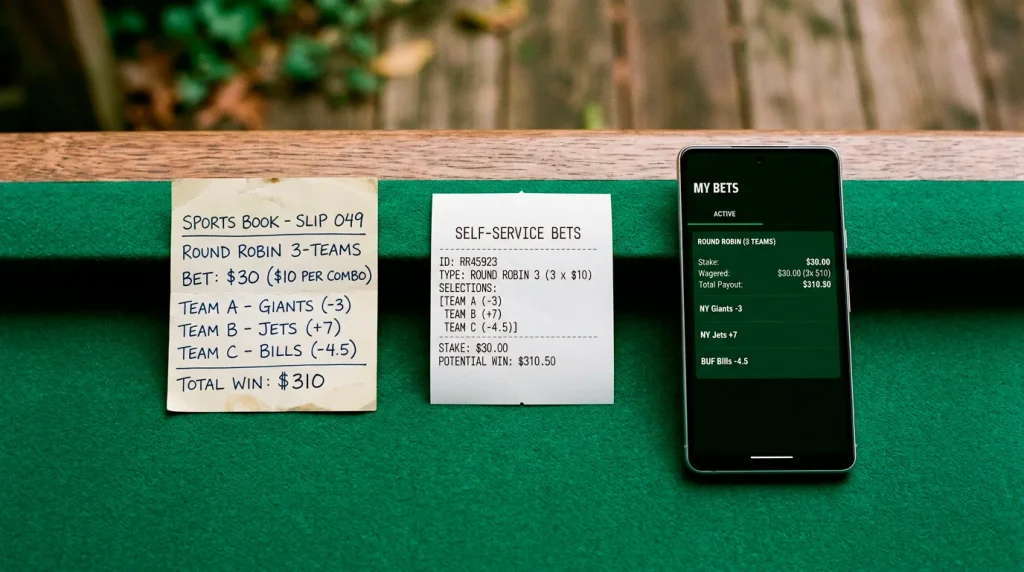
Placing a round robin is straightforward once you have done it. The challenge is the first time — finding the option in an unfamiliar interface, understanding whether “unit stake” means the per-bet amount or the total, and knowing what to say if you are standing at a counter in a betting shop. The bet slip is the last step between analysis and action, and getting it wrong can mean placing the wrong bet type, staking more than you intended, or walking away empty-handed because the cashier did not understand the request.
This guide covers three channels for placing a round robin in Britain: the online bet slip (website or app), the self-service betting terminal (SSBT), and the over-the-counter paper slip. Three channels, one bet — the mechanics differ, but the result is the same ten-component wager.
Round Robin Bet Slip Guide — More on this topic at horse racing round robin.
Online Bet Slip Navigation
Online is the most common route. The process begins by adding three horse racing selections to your bet slip — one horse per race, from three separate events. Most bookmaker websites and apps display the bet slip as a side panel (desktop) or a bottom sheet (mobile) that updates dynamically as you add selections.
With three selections loaded, the bet slip presents a list of available bet types. At a minimum you will see Singles, Doubles, Treble, Trixie, and Patent. The round robin appears in the “multiples” or “system bets” section, sometimes labelled “Round Robin (10 bets)” and sometimes just “Round Robin.” Not every bookmaker offers it online — bet365 is the notable absence — but Betfred, Paddy Power, BoyleSports, William Hill, and Ladbrokes all include it as a standard option.
Select the round robin and a single stake input field appears. This field is for your unit stake — the amount placed on each of the ten component bets. Enter £1 and your total outlay is £10. The slip should display the total prominently, though the exact layout varies by operator. Before confirming, check three things: the total outlay matches your expectation, the selections and odds are correct, and the each-way toggle (if present) is set to your preference. Ticking each-way doubles the bet count to twenty and the cost to £20 at a £1 unit.
Once confirmed, the bookmaker splits your stake across the ten components behind the scenes. You can usually track progress in the “My Bets” or “Open Bets” section, where the round robin appears as one entry with component results updating as races finish. Self-service betting terminals have been growing as a channel for these bets too: GGY from SSBTs rose 32 percent year-on-year to £153 million in late 2024, according to Gambling Commission data, reflecting a wider shift in how punters interact with combination wagers in retail environments.
SSBT Terminal Interface
Self-service betting terminals are the touchscreen machines found in licensed betting shops throughout Britain. They combine the functionality of an online bet slip with the immediacy of a physical location — you browse races, select horses, choose bet types, and pay via cash, card, or account balance.
The SSBT process for a round robin mirrors the online flow but with a few differences. After selecting three horses from three different races, the terminal presents a bet-type menu. On most terminal platforms, “Round Robin” appears alongside Trixie, Patent, and other combination bets. Tap it, enter your unit stake using the on-screen keypad, and confirm.
Terminal interfaces vary by manufacturer and software version. Older terminals may list the round robin under a “Full Cover” sub-menu rather than presenting it directly. If you cannot find it, look for “System Bets” or “Other Multiples” in the navigation. Some terminals abbreviate the bet type as “RR” or display it as “3 sel Round Robin (10 bets).” The key identifier is always the number: ten bets from three selections.
One advantage of the SSBT over online is the ability to check your slip before paying. The terminal displays a summary screen showing each component, the unit stake, and the total outlay. Take a moment to read it. If anything looks wrong — a selection has changed odds, a race has been void, or the bet type is not what you intended — you can cancel and start over without waiting for a customer service chat.
The terminal prints a physical receipt after confirmation. Keep it. This receipt is your proof of bet in the event of a dispute, and unlike an online bet reference (which is stored in your account), a shop receipt can be lost. Photograph it or store it securely until the bet is settled.
Over-the-Counter Phrasing
Over-the-counter placement is the oldest method and the least intuitive for anyone who did not grow up with it. You fill in a paper betting slip — available on the racks in any licensed shop — and hand it to the cashier with your stake.
The phrasing matters. Write your three selections clearly, one per line, with the race time and horse name. Below the selections, write “Round Robin” or “RR” and your unit stake. For example: “RR £1 unit.” If you want each-way, add “E/W” after the unit stake. The cashier should interpret this as a ten-bet round robin at £1 per component, totalling £10 (or £20 each-way).
Some cashiers, particularly less experienced ones, may not immediately recognise “round robin” and could confuse it with a Trixie or Patent. If there is any ambiguity, specify: “Round Robin — that’s three doubles, one treble, and six single stakes about, ten bets total at £1 each.” This level of detail removes guesswork. Alternatively, write the components individually on the slip: “3 × dbl £1, 1 × treb £1, 6 × SSA £1” — though this is slower and defeats the purpose of using a named bet type.
The number of shops where this conversation can happen continues to shrink. Britain now has 5,825 licensed betting offices, per the Gambling Commission, a figure that has fallen by more than a third in the past decade. The shops that remain are concentrated in town centres and high streets, and staff turnover means the depth of knowledge behind the counter is not what it once was. If you rely on the OTC route, developing a relationship with a regular shop and a knowledgeable cashier makes the process smoother.
One final point: over-the-counter bets are settled against the official result, and your receipt is the binding record. If you write the wrong horse name or race time, the bet stands as written. Double-check the slip before handing it over.
Summary
Three channels, one bet. Online: add three selections, find “Round Robin” in the multiples menu, enter a unit stake, confirm. SSBT: same logic on a touchscreen, with a printed receipt. Over the counter: write your selections, mark “RR” with the unit stake, and hand it to the cashier with the confidence of someone who knows exactly what ten bets they are placing.
The common thread across all three channels is the unit-stake trap. The number you enter is per component, not per bet slip. A £1 unit means £10 total. Read the slip, check the total, and confirm only when the numbers match your intention.
