
How to Read a Race Card for Round Robin Selections
 Available in US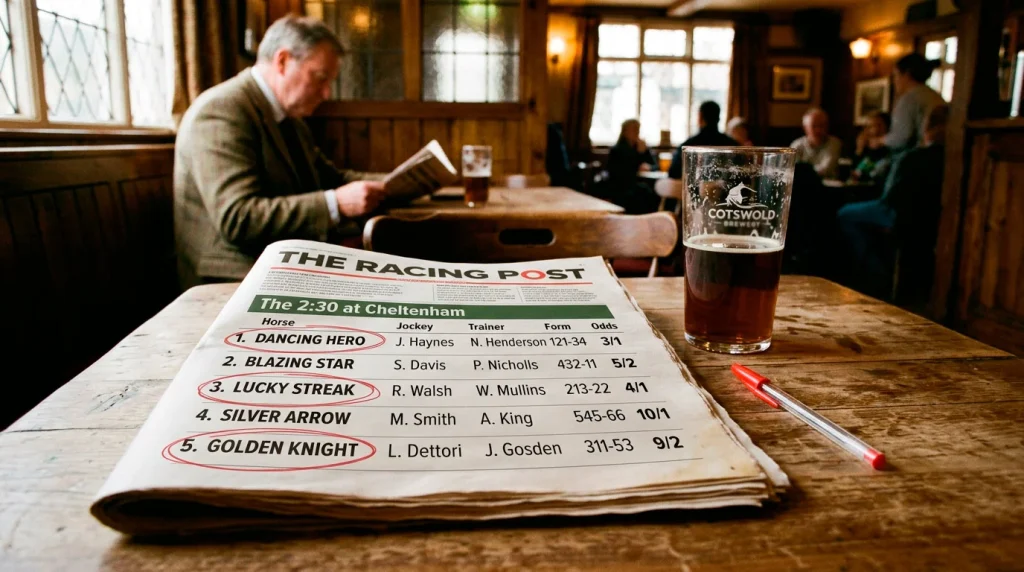
A round robin is only as good as the three horses you put into it. The ten-bet structure offers protection against partial failure, but it cannot rescue selections that were poorly chosen in the first place. Picking three competitive horses — not three hopeful guesses — starts with reading the race card.
The race card is the dense block of data published for every race on a British card. It contains form figures, going preferences, draw information, trainer and jockey statistics, and more besides. For a round robin punter, the card tells you who to pick — or, more precisely, it tells you which horses have earned the right to be considered and which ones can be crossed off before you reach the bet slip. This guide walks through the key elements.
How to Read a Race Card for Round Robin Selections — More on this topic at horse racing round robin.
Form Figures Decoded
Form figures are the string of numbers (and letters) that appear next to each horse’s name on the card. They show finishing positions in the most recent races, reading from left to right with the oldest run first and the most recent last. A horse showing 2131 finished second, then first, then third, then first in its last four outings. A horse showing 0800 finished outside the first nine twice and was either unplaced or pulled up twice.
Several symbols carry specific meanings. A dash (–) separates different seasons. A slash (/) indicates a gap of more than a year between runs. The letter P means the horse pulled up, F means fell, U means unseated its rider, and R means refused. For round robin purposes, these are red flags — not absolute disqualifications, but warnings that the horse may have issues beyond pure ability.
What form figures tell a round robin punter is whether a horse has been consistently competitive. You are not looking for the winner of every race; you are looking for horses that regularly finish in the first three or four positions. A horse showing 3212 across varied courses and distances is a more reliable round robin candidate than one showing 1007, because the round robin’s doubles and SSA pairs reward consistency — a horse that places frequently contributes to partial returns even when it does not win.
Field size adds context to form figures. The BHA’s 2025 Racing Report recorded an average of 8.90 runners per Flat race and 7.84 per Jumps race. A “third” in a five-runner race is less impressive than a “third” in a sixteen-runner handicap. When evaluating form, consider the competitiveness of the races the horse has been running in. A solid run in a strong field at a big meeting carries more weight than a narrow victory in a weak affair at a minor track.
Class indicators on the card — the race grade or class number — help with this assessment. Races range from Class 1 (the highest) to Class 7 (the lowest) on the Flat, and from Grade 1 down to Class 5 over Jumps. A horse dropping in class (moving from Class 3 to Class 4, for example) is often being placed by its trainer in a race it can win. A horse stepping up in class may struggle. For round robin selections, horses racing at the same level as their recent form — or dropping slightly — tend to offer the best combination of competitiveness and fair odds.
Going, Draw, and Distance
The going describes the state of the ground. British racing uses a scale from Hard (rarely seen) through Firm, Good to Firm, Good, Good to Soft, Soft, and Heavy. On all-weather surfaces, the terms are Fast, Standard to Fast, Standard, Standard to Slow, and Slow. Each horse has going preferences, and these are often visible on the race card as a shorthand or in the detailed form book entries.
For a round robin, matching horse to going is essential. A horse whose form reads brilliantly on good ground but who has never encountered soft going is a risk on a rain-soaked Saturday. Conversely, a proven mudlark on heavy ground becomes a strong candidate when the forecast turns wet. Check the going report for each of the three racecourses you are targeting — they may all be different — and ensure each selection has form on the expected surface.
Draw position matters on Flat courses with a straight track or a tight bend. At some courses — Beverley, Chester, and Epsom are classic examples — the draw exerts a measurable influence on winning chances. Low draws may be favoured at some tracks, high draws at others, and the effect changes with the going. The race card typically shows each horse’s stall number. If you are selecting from a race at a draw-biased course, consult the course’s draw statistics before committing.
Distance is the third pillar. Each horse has an optimal distance range, and trainers generally place their horses at distances suited to their stamina profile. The race card shows the distance of today’s race alongside each horse’s previous distances. A horse stepping up in trip for the first time is an uncertain prospect; one running at its proven best distance is a more reliable round robin leg. Look for the “CD” marker on the card, which indicates the horse has previously won at this course and distance — a strong positive signal.
Trainer and Jockey Signals
Trainer statistics appear on the race card in various formats, but the most useful metric is the trainer’s strike rate — the percentage of runners that win. A trainer with a 20 percent strike rate is getting roughly one in five horses home first, which is well above average. More importantly for round robin selection, look at the trainer’s record with the specific horse type: two-year-olds, handicappers, chasers, or whatever the race demands.
Trainer-course combinations are worth noting. Some trainers have a disproportionately good record at particular venues. This information is usually available in the expanded race card or through specialist form sites. A trainer sending a horse to a course where they have a 30 percent strike rate is more bullish than one sending a runner to a track where they have never had a winner.
Jockey bookings carry information too. A leading jockey choosing to ride one horse over another in the same race is a market signal — especially when the jockey has a financial incentive to be on the best horse. Flat jockeys in Britain earn a riding fee of £162.79 per race, while Jump jockeys receive £227.92, according to data compiled by Chepstow Racecourse. The real money, though, is in prize-money percentages and retainer fees from powerful owners. When a top jockey commits to a ride, it typically reflects confidence from the connections.
First-time combinations — a jockey riding a horse for the first time — are not inherently negative, but they lack the familiarity that repeat partnerships develop. For round robin selections, a proven jockey-horse combination with a winning history together is a stronger signal than a new pairing assembled at the last minute.
None of these signals is sufficient on its own. The race card is a mosaic: form, going, draw, distance, trainer, jockey — each piece narrows the field. For a round robin, you need three selections from three different races, each supported by multiple positive signals. One strong indicator does not make a horse a pick. Three or four converging signals do.
Summary
The race card condenses a horse’s competitive history into a few lines of data. Form figures show consistency. Going and distance records show suitability. Draw statistics show positional advantage. Trainer and jockey bookings show intent. Reading these elements together — not in isolation — gives you the foundation for three informed round robin selections.
The card tells you who to pick. It also tells you who to avoid. A round robin built from three horses with converging positive signals stands a better chance of returning money than one built from three hunches. The ten-bet structure provides protection, but protection works best when the underlying selections deserve it.
See also Round Robin Bet Slip Guide.
