What Is a Full Cover Bet? Where Round Robin Fits
 Available in US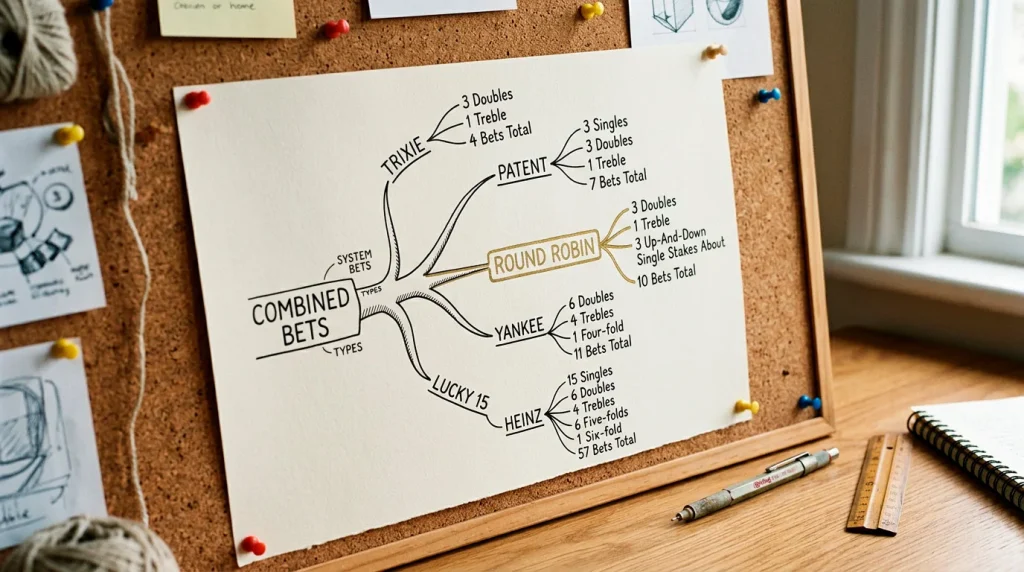
A full cover bet is any wager that includes every possible combination of doubles, trebles, and higher-order accumulators from a set of selections. Some variants add singles; some add conditional pairs. The round robin is one branch of this family tree — and it is the only member that includes single-stakes-about (SSA) pairs, which is precisely what makes it distinctive and occasionally misunderstood. This guide maps the full cover family from three selections up to six, shows where the round robin sits within it, and helps you choose the right structure for your number of picks.
What Is a Full Cover Bet? Where Round Robin Fits — More on this topic at horse racing round robin.
The Full Cover Family: Trixie to Heinz
Full cover bets scale with the number of selections. Each tier has two variants: one without singles and one with. The version without singles requires at least two winners for a return; the version with singles can pay from just one.
Three selections. The Trixie contains four bets: three doubles and one treble. The Patent adds three singles, bringing the total to seven. The round robin replaces those three unconditional singles with six conditional SSA pairs, totalling ten bets. All three bet types cover every possible doubles and treble combination from the same three picks; they differ only in how they treat single-selection coverage.
Four selections. The Yankee contains eleven bets: six doubles, four trebles, and one four-fold accumulator. The Lucky 15 adds four singles for a total of fifteen. A four-selection round robin would contain twenty bets (six doubles, four trebles, one four-fold, and — in theory — twelve SSA pairs from six pairings with two directions each), though this variant is rarely offered on standard bet slips.
Five selections. The Canadian (also called a Super Yankee) has twenty-six bets: ten doubles, ten trebles, five four-folds, and one five-fold. The Lucky 31 adds five singles for thirty-one. SSA versions at this level are effectively non-existent in commercial bookmaker offerings.
Six selections. The Heinz contains fifty-seven bets: fifteen doubles, twenty trebles, fifteen four-folds, six five-folds, and one six-fold. The Lucky 63 adds six singles for sixty-three. At this scale, the cost and complexity of the bet are substantial — a £1 Heinz costs £57 — and the margin compounding identified by Philip Newall’s research becomes severe. Newall found that bookmaker margins on straightforward markets averaged around 5 percent while climbing to 48 percent on exotic constructions during the 2014 World Cup (Judgment and Decision Making, 2015); the house edge on each additional component layer pushes the aggregate expected loss significantly higher than on simpler structures.
The naming convention is not random, though it feels arbitrary. “Lucky” variants include singles and traditionally offered consolation bonuses for one or no winners. “Heinz” references the brand’s “57 varieties” marketing slogan. The Trixie is named after a greyhound. The Yankee’s origin is less certain, possibly referencing American-style multi-leg wagering.
What unites the entire family is structure: every combination of a given leg-count is covered. What separates the members is cost and scope. A Trixie buyer accepts that one winner returns nothing; a Patent buyer pays for one-winner insurance; a round robin buyer pays more again for conditional one-winner coverage. At higher selection counts, the cost-to-coverage ratio deteriorates. A £1 Heinz commits £57 before a single race has run — a serious bankroll decision for what amounts to sixty-three separate margin-carrying wagers.
Where Round Robin Sits — and Why SSA Makes It Unique
The round robin occupies a unique niche in the three-selection tier. Like a Trixie, it includes all doubles and the treble. Like a Patent, it provides coverage for outcomes where only one selection wins. Unlike either, it achieves that one-winner coverage through conditional SSA pairs rather than unconditional singles.
This conditional architecture is the round robin’s defining feature. An unconditional single (as in a Patent) always pays if the selection wins, regardless of what happens in the other races. An SSA pair also pays if the selection wins, but its return depends on the second leg — if the conditional second bet also wins, the SSA return is larger; if it loses, only the leftover profit from the first leg is retained. The SSA is cheaper per unit of coverage than a Patent’s singles (six conditional bets vs three unconditional for comparable one-winner protection) but more expensive in total because the directional pairing doubles the bet count.
No other member of the full cover family includes SSA at any selection count. The Lucky 15, Lucky 31, Lucky 63, and all their non-singles counterparts rely exclusively on unconditional combinations. The round robin’s SSA component is a relic of high-street betting shop culture, where conditional bets were a staple product. Its persistence in the digital era is a testament to the structural elegance of the any-to-come mechanism — and to the handful of bookmakers that chose to maintain it on their platforms.
One consequence of this uniqueness is that the round robin is harder to compare directly with its relatives. A Trixie and a Patent are subsets of the same combinatorial logic — take a Trixie, add three singles, get a Patent. The round robin does not follow that pattern. Its SSA component introduces a conditional dimension that operates differently from any other bet in the family. This makes the round robin genuinely distinct rather than simply an inflated version of its neighbours.
Choosing by Number of Selections
The right full cover bet depends first on how many selections you have and second on how much you are willing to spend.
With three selections, the practical choices are Trixie (£4), Patent (£7), or round robin (£10) at a £1 unit. If you are confident in at least two of your three picks and do not need one-winner protection, the Trixie is the cheapest option. If you want a guaranteed return from one winner, the Patent offers it at moderate cost. If you want one-winner cushioning with more structural nuance — conditional recovery rather than a flat single — the round robin provides it at a higher price.
With four selections, the Yankee (£11) or Lucky 15 (£15) are the standard choices. A four-selection round robin is theoretically possible but almost never available online. If you find yourself wanting four picks, the Yankee is the pragmatic route.
With five or six, the costs escalate rapidly. A £1 Lucky 31 costs £31; a £1 Heinz costs £57. Average field sizes in British racing — 8.90 on the Flat and 7.84 over Jumps per the BHA’s 2025 Racing Report — mean that finding five or six genuine contenders across a single card is a challenge. The temptation to pad a larger full cover with speculative picks weakens the entire structure. For most recreational punters, three or four selections is the productive range, and within that range the round robin and Trixie cover the ground that matters.
Summary
The full cover family spans from the four-bet Trixie to the sixty-three-bet Lucky 63, scaling in cost and complexity with each added selection. The round robin sits in the three-selection tier alongside the Trixie and Patent, distinguished by its six SSA conditional pairs — a feature no other full cover bet shares.
The family tree of combination bets is wide, but the practical choices are narrow. Pick the tier that matches your selection count, choose the variant that fits your budget and risk tolerance, and remember that every additional component adds both coverage and margin. The round robin’s SSA architecture makes it unique. Whether that uniqueness justifies the premium is a decision only your bankroll and your race card can answer.
See also Union Jack Round Robin.
