
UK vs US Round Robin Bet: Why 10 Bets Here, 7 There
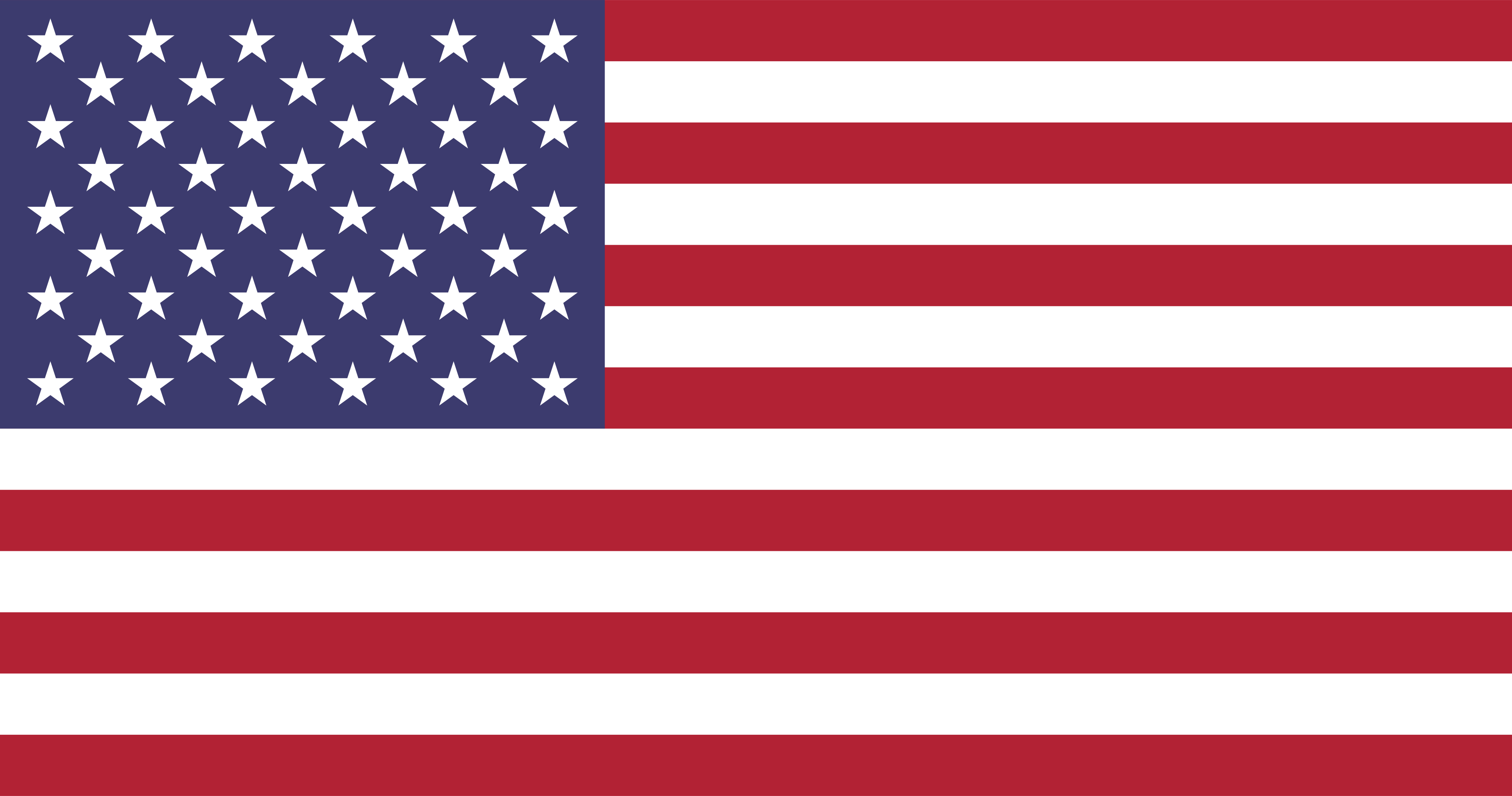 Available in US
A British punter and an American bettor can both walk into their respective betting environments, ask for a round robin on three selections, and receive completely different bets. Same name, different maths. The UK version contains ten bets. The US version contains seven — sometimes described as three two-team parlays and one three-team parlay, sometimes as just the parlay combinations without a treble at all, depending on the sportsbook.
The gap is not a quirk or an error. It reflects two betting cultures that evolved independently, adopted the same label for related but distinct concepts, and never reconciled the difference. For anyone who reads American betting content, follows NFL or NBA tips, or simply tries to Google “round robin bet” without specifying a country, the confusion is almost guaranteed. This article maps the structural, cultural, and practical differences so that the next time you see the term, you know exactly which version is being discussed.
UK vs US Round Robin Bet — More on this topic at horse racing round robin.
Structural Difference: SSA vs Parlay Combos
The UK round robin on three selections produces ten bets: three doubles, one treble, and six single-stakes-about (SSA) singles. The SSA pairs are conditional wagers — if the first leg wins, a single at the unit stake is placed on the second leg. Each pair runs in both directions, giving six directional bets from three two-horse combinations.
The US round robin on the same three selections produces a different set entirely. American sportsbooks define a round robin as every possible parlay combination from a group of selections. With three picks, that means three two-leg parlays (AB, AC, BC). Some sportsbooks add the three-leg parlay (ABC) automatically; others leave it as a separate option. There are no conditional singles. The SSA component does not exist in American betting vocabulary.
The structural consequence is significant. In the UK version, a single winner out of three still triggers some SSA returns — the winning selection’s profit funds conditional bets on the losing ones, and while those second legs fail, the leftover profit from the first leg is retained. In the US version, a single winner out of three returns nothing: every parlay requires at least two legs to win.
The cost differs accordingly. A £1 UK round robin costs £10 (ten bets at £1 each). A $1 US round robin on three selections costs $3 or $4 depending on whether the sportsbook includes the three-leg parlay — three or four bets at $1 each. The UK bet is more expensive because it buys more coverage.
Taxation adds another layer of divergence. Remote bets on British horse racing carry a 15 percent duty rate — a level that has been explicitly protected from the forthcoming increase to 25 percent on other remote betting, according to an HM Treasury policy paper. In the United States, federal excise tax on wagers is minimal (0.25 percent of the handle for legal operators), but state-level taxation of sportsbook revenue varies wildly, from zero in some jurisdictions to over 50 percent in others. The bettor does not pay these taxes directly in either country, but they influence the odds and margins offered by operators — and therefore the value embedded in every component of a round robin.
Cultural Origins: High Street vs Sportsbook
The UK round robin grew up in betting shops. From the 1960s onwards, high-street bookmakers offered a menu of combination bets that could be written on a paper slip and handed to the cashier: Trixies, Patents, Yankees, Lucky 15s, and round robins. The SSA component — the conditional “any-to-come” single — was a natural feature of this environment. A shop assistant could process the logic because they understood the sequential settlement: wait for Race 1, check the result, trigger the conditional bet on Race 2 if applicable. The round robin was designed for a world where bets were placed in person and settled by hand.
American sports betting developed along a different path. For most of the twentieth century, legal betting was confined to Nevada, and the dominant product was the parlay — a multi-leg accumulator where all selections must win. When states began legalising sports wagering after 2018, the digital sportsbooks that launched inherited the parlay-centric model. The “round robin” label was applied to the act of combining selections into every possible parlay subset, not to a distinct bet type with conditional singles.
The decline of Britain’s high-street betting infrastructure underscores why the UK round robin is increasingly an online product looking for a home. An HM Treasury review documented that physical bookmaker revenue nearly halved over the past decade — from £3.3 billion to £2.5 billion in GGY — while shop numbers shrank by a third. The shops that gave birth to the round robin are thinning out, and the bet type’s survival depends on whether online platforms choose to support its SSA architecture — something American sportsbooks never had reason to build.
When Terminology Causes Confusion
Search “round robin bet” on Google and the results blend both definitions without warning. American sportsbook guides describe a round robin as “every possible parlay combination from your selections.” British betting sites describe it as “a full-cover bet with doubles, a treble, and SSA singles.” Both are correct within their own context. Neither acknowledges the other.
This creates real problems for punters researching the bet for the first time. A UK bettor reading an American guide might conclude that a round robin costs only three or four units — then be surprised when the British bet slip shows ten. An American bettor encountering a UK explanation might wonder what SSA stands for and why there are six extra bets they did not ask for.
The confusion extends to calculators and tools. A round robin calculator built for the US market will not produce correct results for a UK round robin, because it does not include the SSA component. Conversely, a UK calculator will overstate the cost and return if the user intends to place the American version. Always check whether the tool specifies which country’s definition it uses. If it does not, look at the number of bets: ten means UK, three or four means US.
Even within the UK, the terminology is not perfectly stable. Some bookmakers label the SSA component as “up-and-down” bets; others fold it silently into the round robin total without naming it. Betfred shows “Round Robin (10 bets)” on its slip, which is clear. Other operators show a round robin alongside a Trixie without explaining why the round robin costs more than twice as much. The label is only useful if the person reading it already knows what it contains.
For British horse racing, the round robin always means the ten-bet version. If you are placing the bet on a UK-licensed bookmaker on UK racing, there is no ambiguity. The American definition is irrelevant to your slip. It only becomes relevant when you cross borders — literally or digitally — and find that the same words now describe a smaller, cheaper, structurally different bet.
Summary
The UK round robin is ten bets: three doubles, one treble, six SSA singles. The US round robin is three or four parlays: every two-leg and sometimes the three-leg combination, with no conditional singles. Same name, different maths, different heritage.
The distinction matters whenever you read betting content, use a calculator, or discuss strategy with someone on the other side of the Atlantic. In a British context, the round robin is a full-cover bet with built-in partial-loss protection. In an American context, it is a shortcut for building multiple parlays from one selection pool. Know which version you are dealing with, and the numbers will never surprise you.
See also Round Robin Bet Returns.
