
Round Robin vs Trixie vs Patent: Which Bet Wins?
 Available in US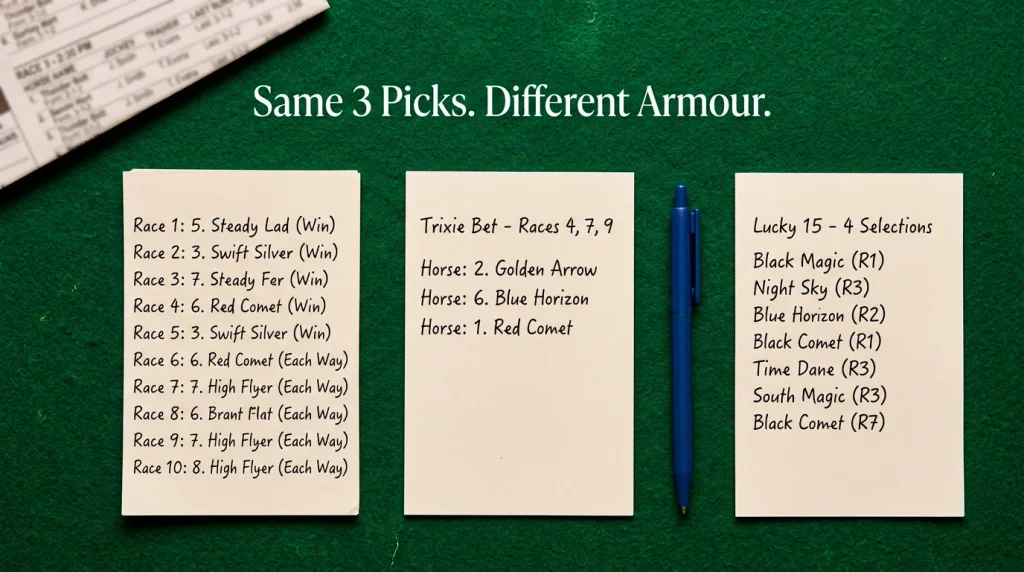
Three selections, three bet types, and three very different outcomes when the afternoon does not go to plan. A round robin, a Trixie, and a Patent all start from the same three picks, yet they distribute risk and reward in ways that are not interchangeable. The round robin fields ten bets including six conditional SSA singles. The Trixie packs four — three doubles and a treble — with no safety net underneath. The Patent spreads across seven bets by adding three outright singles to the Trixie frame. Same three picks, different armour.
The comparison matters because most punters default to one of these bet types without testing the alternatives against real numbers. A round robin vs Trixie debate settled by feel rather than arithmetic leaves money on the table — or, more often, in the bookmaker’s margin. This article resolves the debate with side-by-side numbers: cost per unit, payout under four scenarios (zero, one, two, and three winners), and expected value modelled against published bookmaker margins.
The aim is not to crown a single winner. Each bet type excels in a different situation, and the right choice depends on your odds profile, your bankroll, and how you define a successful day at the races. What follows is the data you need to make that choice deliberately rather than by habit.
Round Robin vs Trixie vs Patent — More on this topic at horse racing round robin.
Structural Overview: What Each Bet Contains
Start with the Trixie, the simplest of the three. A Trixie on selections A, B, and C comprises four bets: three doubles (A+B, A+C, B+C) and one treble (A+B+C). Every bet in a Trixie is a multiple — two or more legs that must all win for a return. There are no singles. If only one selection wins, the Trixie pays nothing. The minimum condition for any return is two winners out of three.
The Patent adds a layer beneath the Trixie. It contains the same three doubles and one treble, plus three outright singles — one on each selection. That brings the total to seven bets. The singles mean that a Patent pays something whenever at least one selection wins, because even a solitary winner returns through its standalone single. The trade-off is cost: seven units instead of four.
The round robin occupies different ground entirely. It includes the same three doubles and one treble as the Trixie, but instead of outright singles, it adds six single-stakes-about (SSA) wagers — conditional bets arranged in three pairs. Each pair links two selections: if A wins, the profit stakes B, and if B wins, the profit stakes A. The same logic applies to A↔C and B↔C. The total is ten bets. The SSA component provides partial recovery in single-winner scenarios, though the mechanism is conditional rather than guaranteed.
The structural difference between a Patent’s singles and a round robin’s SSA singles is the crux of the comparison. A Patent single on selection A at 5/1 pays £6 for a £1 stake regardless of what B and C do. A round robin’s SSA single A→B only generates a return if A wins and the resulting profit is then used to back B, which must also win. The Patent single is unconditional; the SSA single is conditional. This distinction shapes every payout scenario that follows.
In tabular form, the composition is clean. The Trixie contains three doubles and one treble, totalling four bets. The Patent contains three singles, three doubles, and one treble, totalling seven bets. The round robin contains three doubles, one treble, and six SSA singles, totalling ten bets. All three share the doubles-and-treble core; they differ only in what sits beneath it. The Trixie has nothing beneath it. The Patent has unconditional singles. The round robin has conditional singles. That structural choice drives everything — cost, payout, expected value, and suitability.
Numbers at a Glance: Cost and Composition
At a £1 unit stake, a Trixie costs £4, a Patent costs £7, and a round robin costs £10. Those figures scale linearly: at £2 per unit the totals are £8, £14, and £20; at £5 they become £20, £35, and £50. The round robin is two and a half times the price of a Trixie and roughly 43 per cent more expensive than a Patent. That premium buys six additional SSA bets — but whether those bets earn their keep depends on the scenario.
The cost gap also changes the implied break-even requirement. A £10 round robin needs to return more than £10 across its ten components to profit. A £4 Trixie needs only to clear £4. In the two-winner scenario — the outcome that defines the practical difference between these bets — the doubles do most of the work in all three types. The round robin’s SSA legs add a bonus on top, but that bonus must be weighed against the extra six units of stake.
Where cost becomes a more subtle issue is in margin exposure. Academic research on bookmaker pricing has consistently shown that margins on combination bet types are substantially higher than on simple wagers — a dynamic explored in detail in the EV section below. The practical consequence is that each additional bet line in a combination wager gives the bookmaker another edge. A Trixie exposes you to margin on four bets. A Patent, on seven. A round robin, on ten. The cost per unit is identical, but the total margin extracted by the bookmaker scales with the number of lines.
This does not automatically make the Trixie the best value. Margin is only one variable; the other is the probability of generating a return. If the round robin’s extra six bets produce returns that more than offset the margin charged on them, the additional cost is justified. If they do not — and at short odds, they rarely do — the Trixie’s leaner structure delivers better efficiency per pound staked. The scenario analysis that follows puts hard numbers on this trade-off.
One more point on composition. The Patent’s three singles, at a cost of three units, guarantee a return whenever one selection wins. The round robin’s six SSA singles, at a cost of six units — double the Patent’s single-coverage cost — only generate a return if the conditional chain completes. In the single-winner scenario, the Patent consistently outperforms the round robin in return-on-cost terms. That asymmetry is the core pricing tension in the round robin vs Patent debate.
Risk vs Reward: Scenario Payouts Compared
The only way to compare these three bet types honestly is to run them through identical odds and identical outcomes. Take selections A at 5/1, B at 3/1, and C at 7/2 — a realistic spread for three competitive horses across an afternoon card. Unit stake: £1 throughout.
Zero Winners
Trixie: loss of £4. Patent: loss of £7. Round robin: loss of £10. No bet type offers any consolation here. The entire stake is forfeit in all three cases. The round robin loses the most in absolute terms because it has the most lines. As a percentage of stake, the loss is always 100 per cent regardless of which bet you chose. The only strategic implication is that the round robin commits the most capital to a scenario where nothing returns, which matters for bankroll management.
One Winner — Selection A at 5/1
Trixie: all three doubles need two winners; the treble needs three. With only A winning, every component is void. Return: £0. Loss: £4.
Patent: the three doubles and treble are void, exactly as in the Trixie. But the single on A at 5/1 returns £6 (decimal 6.00 × £1). Return: £6. Profit: £6 minus £7 stake = –£1. The Patent limits the damage to a £1 loss rather than a total wipeout.
Round robin: doubles and treble are void. The SSA legs A→B and A→C trigger — A’s £5 profit runs on B and C respectively — but both B and C lost, so those triggered bets return nothing. The other four SSA legs never trigger because B and C did not win. Return: £0. Loss: £10.
This scenario is the Patent’s strongest argument. It is the only bet of the three that provides a tangible return when just one selection lands. Data from GrandNational.fans shows that favourites in British racing win about 30 to 35 per cent of the time. Across three selections that are not all favourites, the probability of exactly one winner is not negligible — it may well be the single most likely outcome on a given slip. In that scenario, the Patent outperforms both the Trixie (total loss) and the round robin (total loss, with more capital at risk).
Two Winners — A and B Win, C Loses
Trixie: Double A+B pays £24 (6.00 × 4.00). Doubles A+C and B+C are void. Treble is void. Return: £24. Profit: £20.
Patent: same double A+B pays £24. Singles on A and B pay £6 and £4 respectively. Return: £24 + £6 + £4 = £34. Profit: £27.
Round robin: Double A+B pays £24. SSA A→B triggers and completes (A wins, profit £5 runs on B at 4.00 = £20). SSA B→A triggers and completes (B wins, profit £3 runs on A at 6.00 = £18). The other four SSA legs either trigger but fail (A→C, B→C) or never trigger (C→A, C→B). Return: £24 + £20 + £18 = £62. Profit: £52.
Here the round robin dominates. Its £52 profit is nearly double the Patent’s £27 and more than double the Trixie’s £20. The SSA legs between the two winning selections both complete, adding £38 that neither the Trixie nor the Patent can access. The round robin’s premium of six extra units over the Trixie (£6) bought an additional £38 in this scenario — a return on the incremental investment of over 600 per cent.
Three Winners — A, B, and C All Win
Trixie: three doubles (£24 + £27 + £18) plus treble (£108) = £177. Profit: £173.
Patent: same doubles and treble (£177) plus three singles (£6 + £4 + £4.50) = £191.50. Profit: £184.50.
Round robin: doubles (£69) plus treble (£108) plus six SSA legs (£20 + £18 + £22.50 + £21 + £13.50 + £14) = £286. Profit: £276.
The round robin returns £286 against the Patent’s £191.50 and the Trixie’s £177. All six SSA legs fire and complete, generating £109 in aggregate — more than the treble itself. When everything wins, the round robin’s ten-bet structure captures compounding value that simpler bet types cannot match.
Summary of Scenario Returns
At these odds, the pattern is clear. The Trixie is cheapest and returns nothing unless two selections win. The Patent provides a cushion in the single-winner scenario at moderate extra cost. The round robin costs the most but dominates when two or three selections win, thanks to the SSA conditional engine. The choice reduces to a probability judgement: how likely are you to get two or more winners from your three selections?
Expected Value Head-to-Head
Scenario payouts show what happens when the race is over. Expected value (EV) shows what is likely to happen before the race starts. It is the probability-weighted average return across all outcomes, and it captures the bookmaker’s margin that the scenario table alone cannot reveal.
To model EV, start with implied probabilities. A horse at 5/1 (decimal 6.00) carries an implied probability of roughly 16.7 per cent before any overround adjustment. At 3/1 (4.00), the implied probability is 25 per cent. At 7/2 (4.50), it is approximately 22.2 per cent. These figures assume a fair market with no margin. In practice, the bookmaker’s overround inflates the sum of all implied probabilities beyond 100 per cent, meaning the true probability of each horse winning is lower than the odds suggest.
Research by Whelan and Hegarty, published in Applied Economics in 2025, demonstrated that standard overround formulas underestimate the bettor’s actual expected losses by around 20 per cent for football markets and up to 40 per cent for tennis. The mechanism is straightforward: bookmakers do not distribute overround evenly across all outcomes. They load more margin onto longer-priced selections, where punters are less price-sensitive, and less onto shorter-priced favourites. For a round robin that typically targets mid-range odds — the 3/1 to 7/1 window — this skewed loading means the effective margin sits above what a simple overround calculation would suggest.
Newall’s earlier work reinforced this point. “Complex bets generally carry odds that lead to a greater expected loss margin for the bettor,” Newall and colleagues wrote in Judgment and Decision Making. For the 2014 World Cup, margins averaged 5 per cent on simple match-winner bets but reached 48 per cent on first-goalscorer markets. While horse racing multiples are not directly comparable to football specials, the principle that complexity compounds margin applies across all combination bet types — Trixies, Patents, and round robins included.
With that context, the EV comparison between the three bets sharpens. A Trixie, with four bets, incurs margin on four lines. A Patent, with seven bets, incurs margin on seven. A round robin, with ten, incurs margin on ten. The marginal cost of moving from a Trixie to a round robin is not just six extra pounds at a £1 unit stake — it is also the margin charged on those six extra lines. If the bookmaker’s effective margin on SSA-type bets sits at 8 to 12 per cent (a conservative estimate for mid-range multiples), the six extra lines cost an additional 48 to 72 pence in expected margin at a £1 stake. Over fifty round robins, that compounds to between £24 and £36 in margin alone — money that would not have been lost on a Trixie.
The EV picture favours the Trixie for punters whose selections win at rates below roughly 30 per cent each. At those strike rates, the two-winner scenario is uncommon enough that the round robin’s SSA bonus fires infrequently, and the six extra lines drain value through margin without generating offsetting returns. For punters who consistently select at strike rates above 30 per cent — roughly the rate at which favourites win in British racing — the round robin’s higher ceiling in two-winner and three-winner scenarios can outweigh the margin drag.
The Patent occupies the middle. Its EV benefit over the Trixie lies in the single-winner return that limits losses on bad days. Its EV disadvantage relative to the round robin lies in the lower ceiling on good days. Over a long series of bets, the Patent tends to produce the smallest variance — fewer devastating losses, fewer spectacular wins. For punters who value consistency over ceiling, that stability has genuine value, even if the raw EV difference is marginal.
Decision Framework: When to Choose Which
The numbers are on the table. Translating them into a decision requires matching each bet type to the situation in front of you — your odds range, your confidence level, your bankroll, and the type of racing you are betting on.
Choose the Trixie when your confidence in all three selections is high and you want maximum efficiency. The Trixie wastes no capital on insurance: every pound goes into doubles and the treble, all of which need two or three winners. If you are picking short-to-mid-priced selections — 2/1 to 4/1 — where two-from-three is a realistic expectation, the Trixie delivers the best return per pound. It is also the correct choice for tight budgets. At £4 per unit, it commits the least capital and allows room for other bets on the card.
Choose the Patent when you want downside protection at moderate cost. The Patent’s three outright singles ensure that any single winner returns something — not a profit at moderate odds, but enough to claw back most of the stake. Data from Entain shows that close to half of all Grand National bettors stake £5 or less, suggesting a large share of the betting public operates on session budgets where losing the entire stake stings. For those punters, the Patent’s near-guaranteed partial return on a one-winner day has practical value beyond what EV alone captures. It keeps the afternoon afloat.
Choose the round robin when you are targeting mid-to-long odds — 3/1 to 7/1 per selection — and you believe two winners from three is achievable. The SSA conditional engine earns its cost in the two-winner scenario, where it adds substantial returns on top of the surviving double. If you routinely pick in the 4/1 to 6/1 range and your strike rate sits around the 30 per cent mark, the round robin’s two-winner payout is meaningfully higher than both the Trixie and the Patent, and the six extra units of stake pay for themselves many times over when the scenario hits.
Avoid the round robin at very short odds (under 2/1). The SSA legs generate tiny profits from short-priced winners, and those tiny profits running as singles on the next selection produce returns that barely justify the six-unit premium over a Trixie. Equally, avoid the round robin at very long odds (above 10/1). The probability of two winners from three drops sharply, and the ten-unit cost becomes a heavy burden that the rare all-win treble cannot consistently offset.
One often-overlooked factor is time horizon. If you place one combination bet a month, the choice between these three types matters less — variance dominates over small sample sizes. If you place combination bets weekly, the accumulated margin difference becomes significant, and selecting the right structure for each set of odds compounds into a material edge over a season. The framework is not a one-time decision; it is a habit that rewards reassessment every time the odds profile changes.
Beyond Three Selections: Yankee, Lucky 15, Flag
The Trixie, Patent, and round robin exist exclusively in the three-selection space. Once you move to four selections, the bet types change names and the structures expand dramatically. Knowing what sits beyond three selections helps clarify why the three-selection tier is the most popular starting point — and why the jump to four selections is not a casual upgrade.
A Yankee is the four-selection equivalent of a Trixie: six doubles, four trebles, and one four-fold accumulator. Eleven bets in total, no singles. Like the Trixie, it pays nothing unless at least two selections win. The cost at £1 per unit is £11 — more than a three-selection round robin — and the number of losing scenarios increases because four horses must contribute at least two winners for a return.
A Lucky 15 is the four-selection equivalent of a Patent: the same eleven multiples as a Yankee, plus four outright singles. Fifteen bets in total, at a cost of £15 per unit. The singles ensure a return from any single winner. Many bookmakers offer bonuses on Lucky 15 bets — a consolation payout if only one selection wins, or enhanced odds if all four win — which makes the Lucky 15 one of the most promoted bet types in UK high-street and online shops.
A Flag is the four-selection round robin equivalent, though the nomenclature gets less standardised at this level. A Flag adds SSA-type conditional bets to the Yankee structure, producing 23 bets in total. The cost at £1 per unit is £23, which puts it firmly in the territory of committed staking. The SSA logic that drives the three-selection round robin operates across a larger permutation set, and the number of conditional pairs grows from three to six. The return profile follows the same pattern as the three-selection comparison: the Flag outperforms the Yankee in the two-or-more-winner scenario, but at a steeper cost.
Beyond four selections, the names continue — Super Yankee (or Canadian) at five, Heinz at six, Super Heinz at seven, Goliath at eight. Each step adds more lines, more cost, and more margin exposure. A Heinz, for instance, contains 57 bets. A Goliath contains 247. These are exotic wagers used almost exclusively by professional or very experienced punters who are comfortable managing the maths.
For most punters entering the combination-bet space for the first time, three selections remain the practical entry point. The Trixie, Patent, and round robin offer enough structural variety to match different risk appetites, at costs that remain manageable on a typical afternoon’s budget. Moving to four or more selections multiplies both the opportunity and the exposure, and should only follow once the three-selection dynamics — including the scenario payouts and margin effects covered in this article — are fully understood.
See also Round Robin Bet Calculator.
