
SSBT and Round Robin: Placing Bets at Self-Service Terminals
 Available in US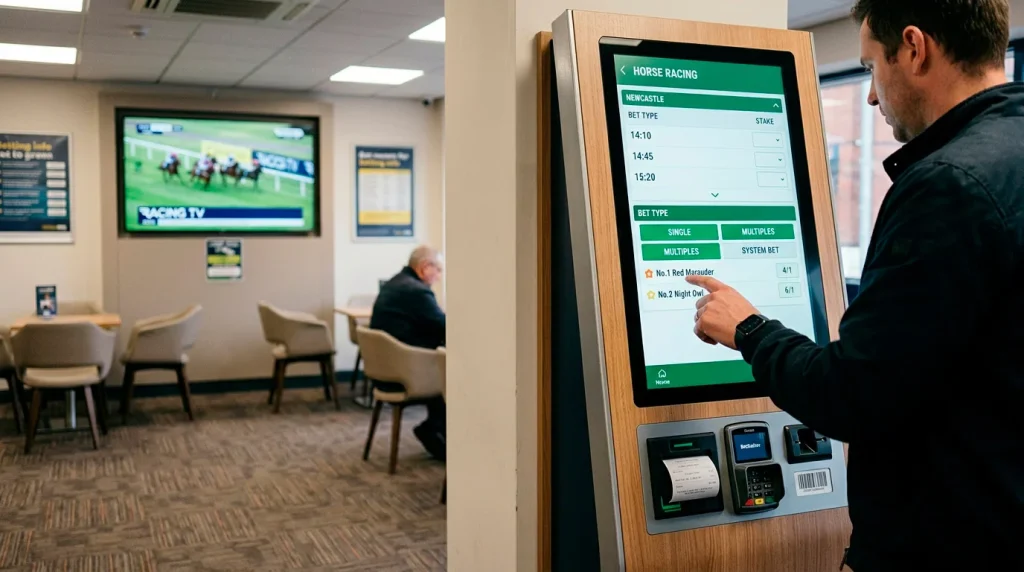
The self-service betting terminal may be the single most important reason the round robin still exists as a mainstream bet type. While online platforms either carry or skip the round robin depending on their heritage, SSBTs in betting shops across Britain reliably surface it as a menu option — complete with SSA components, each-way toggles, and a touchscreen interface that handles the ten-bet settlement without requiring the punter to explain the mechanics to a cashier. The terminal that kept round robin alive is also the channel that quietly modernised it for a generation of bettors who never used a pencil and slip.
SSBT and Round Robin — More on this topic at horse racing round robin.
SSBT Growth and Market Share
Self-service betting terminals have been growing faster than any other in-shop channel. According to Gambling Commission market data, SSBT gross gambling yield rose 32 percent year-on-year to £153 million in the quarter ending December 2024 — a new high for the data series. That growth came as over-the-counter betting continued its long decline, with shop footfall falling and the number of experienced counter staff shrinking.
The shift from counter to terminal has practical implications for combination bets. Over-the-counter round robin placement requires the cashier to recognise the bet type, understand the SSA component, and process the settlement correctly. SSBT placement requires the bettor to tap three selections and choose “Round Robin” from a list. The terminal does the rest. For a bet type whose biggest barrier to usage has always been comprehension — many punters cannot explain SSA, and many cashiers struggle with it too — the terminal removes the human bottleneck.
Anne Lambert, Interim Chair of the Horserace Betting Levy Board, noted that the Levy yield reaching around £108 million provided reassurance for spending decisions heading into 2026. That revenue flows partly from the bets placed on SSBTs in shops across the country. The terminal is not just a convenience device — it is a meaningful contributor to the financial ecosystem that sustains British racing.
The major operators — Betfred, William Hill, Ladbrokes, Coral, and Paddy Power — all deploy SSBTs in their shop networks. Terminal density varies by operator and location, but a typical mid-sized shop has two to four units. Larger flagship premises may have more. The software running on these terminals is updated periodically, and the range of bet types available can change with each update — though the round robin has been a consistent presence across major platforms.
For punters who find online bet slips overwhelming or who prefer the physicality of being in a shop while still wanting screen-based convenience, the SSBT occupies a productive middle ground. You can browse race cards on the terminal’s display, compare prices, and take your time without the pressure of a queue behind you. The terminal does not rush you, does not misinterpret your handwriting, and does not need to be told what SSA stands for.
Navigating Round Robin on the Terminal
The SSBT interface follows a logical sequence: select sport, select meeting, select race, select horse, repeat for the second and third selections, then choose bet type.
After loading three selections from three different races, the terminal presents a bet-type menu. The specific layout depends on the software version, but the round robin typically appears in a “Multiples” or “System Bets” section alongside Trixie, Patent, and other combination options. Tap “Round Robin.” The terminal displays a stake input field — this is the unit stake — and calculates the total outlay in real time. At £1 per unit, the total shows £10. At 50p, it shows £5.
The each-way option, where available, sits adjacent to the stake field or as a separate toggle. Activating it doubles the bet count to twenty and the outlay accordingly. Some terminal versions display a component breakdown before confirmation — listing the three doubles, one treble, and six SSA pairs individually — while others show only the summary (bet type, total stake, potential return at current odds).
Confirm the bet by tapping the “Place Bet” button and inserting cash or swiping a card. The terminal prints a receipt that serves as your proof of bet. This receipt includes the bet reference number, the ten component bets (sometimes summarised, sometimes listed individually), and the total stake. Keep it.
Settlement happens automatically. As race results come in, the terminal’s backend resolves each component. You can check progress by scanning the receipt barcode at the terminal or at the counter. Partial settlements — where some components are won or voided while others are pending — are normal and displayed as such. The final payout, once all three races are complete, is available for collection at the counter or via the terminal’s cash-out function where supported.
A few practical tips for SSBT round robin placement. First, check that all three of your races are still scheduled before placing — abandonments and delays are not always updated on the terminal instantly. Second, if the terminal freezes or fails to process the bet, ask shop staff to check whether the wager was registered. Do not re-enter the bet without confirmation, as you risk placing it twice. Third, if you are unfamiliar with the terminal’s interface, visit the shop outside of busy periods — a Saturday afternoon twenty minutes before the first race is not the time to learn the system.
Tax Advantage: SSBT Stays at 15%
One detail that few punters consider is the tax treatment of SSBT bets. From April 2027, General Betting Duty on remote sports betting will rise to 25 percent of net revenue — but bets placed on British horse racing, whether online or via SSBT, are excluded from this increase and remain at the current 15 percent rate, according to HM Treasury. The 15 percent rate, combined with the existing 10 percent Levy contribution, means that horse racing bets already carry a de facto 25 percent duty — the new headline figure for other sports simply brings the rest of the market to parity.
For the bettor, this tax difference is invisible — UK punters do not pay betting duty directly. The bookmaker absorbs it, and the cost is reflected in the odds. But the protection of the 15 percent rate for racing bets signals regulatory support for the sport’s betting ecosystem, including the in-shop channels where SSBTs operate. Bookmakers have less incentive to close racing-focused shop functions when the tax regime explicitly favours the product those shops were built to sell.
This means the SSBT is not just a surviving technology — it is a commercially rational one. The terminal serves a product (horse racing bets) that carries a favourable tax rate in an environment (the betting shop) that still generates meaningful revenue. As long as these conditions hold, the SSBT — and the round robin it carries — has a place in the landscape.
Summary
Self-service betting terminals have become the most reliable in-shop channel for round robin placement. SSBT revenue grew 32 percent year-on-year to £153 million, and the touchscreen interface removes the knowledge barrier that made counter placement dependent on experienced staff. The terminal kept round robin alive by making it accessible to anyone who can tap three horses and read a menu.
Navigate to your three selections, choose Round Robin, enter the unit stake, and confirm. The terminal prints a receipt, settles each component as results arrive, and pays out when the last race is done. For a bet type born on paper slips, the SSBT is a surprisingly comfortable home.
See also Round Robin Glossary.
