
Fractional vs Decimal Odds in Round Robin Calculation
 Available in US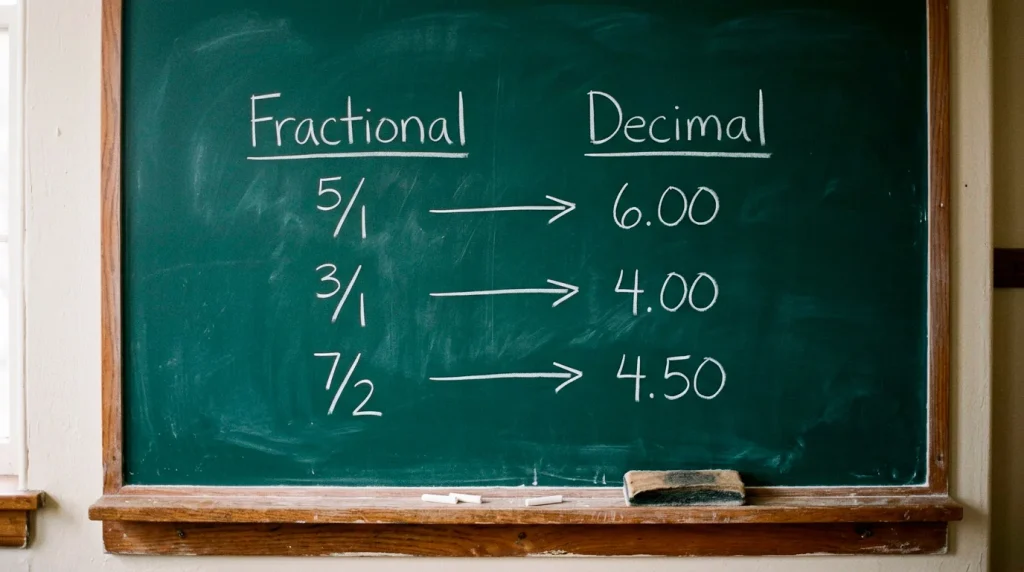
British horse racing speaks fractional odds. The industry quotes prices as 5/2, 7/4, 11/8 — a language that punters have understood for generations. But round robin return calculations speak decimal. Every formula for doubles, trebles, and SSA singles works by multiplying decimal odds together, and if you feed fractional values into a decimal formula, the answers come out wrong.
This article covers the conversion between the two formats, explains why getting the format right is essential for round robin calculations, and flags the specific pitfalls — rounding errors, non-standard fractions, and implied probability distortions — that catch people out when switching between systems. Get the format right, get the return right.
Fractional vs Decimal Odds in Round Robin Calculation — More on this topic at horse racing round robin.
Fractional to Decimal Conversion
The conversion formula is one step: divide the first number by the second, then add one.
Decimal odds = (Numerator ÷ Denominator) + 1
At 5/2: (5 ÷ 2) + 1 = 3.50. At 3/1: (3 ÷ 1) + 1 = 4.00. At 11/8: (11 ÷ 8) + 1 = 2.375. At 1/2: (1 ÷ 2) + 1 = 1.50. The formula works for every fractional price, no exceptions.
The reverse — decimal to fractional — is slightly messier. Subtract one from the decimal odds to get the profit per pound, then express that as a fraction. Decimal 3.50 becomes 3.50 – 1 = 2.50, which is 5/2. Decimal 2.375 becomes 1.375, which is 11/8. Some decimal values do not convert to clean fractions: decimal 2.60 is 1.60 profit, which is 8/5 — a fraction rarely seen on British race cards. Bookmakers round these to the nearest conventional fractional price, which introduces a small discrepancy.
The most common fractional odds in British racing and their decimal equivalents form a set worth memorising if you work with round robins regularly:
| Fractional | Decimal | Implied Probability |
|---|---|---|
| 1/5 | 1.20 | 83.3% |
| 1/2 | 1.50 | 66.7% |
| Evens | 2.00 | 50.0% |
| 6/4 | 2.50 | 40.0% |
| 2/1 | 3.00 | 33.3% |
| 5/2 | 3.50 | 28.6% |
| 3/1 | 4.00 | 25.0% |
| 4/1 | 5.00 | 20.0% |
| 5/1 | 6.00 | 16.7% |
| 10/1 | 11.00 | 9.1% |
Implied probability — the rightmost column — is simply the inverse of the decimal odds: 1 ÷ decimal odds. This becomes important when assessing whether a round robin offers value, because the bookmaker’s margin is embedded in the gap between implied and true probability.
One format note for punters who switch between British and international betting platforms: some European and Asian bookmakers display odds in decimal format by default, and their decimal values sometimes include an extra digit of precision (e.g. 3.75 instead of rounding to the nearest conventional UK fractional step). This extra precision is not an error — it reflects a more granular pricing model. When inputting these values into a round robin calculator, use the full decimal as displayed rather than converting back to a fractional approximation and then reconverting.
Impact on Round Robin Calculations
Every round robin return formula multiplies decimal odds. A double on two selections at 3/1 and 5/2 is calculated as 4.00 × 3.50 × £1 stake = £14.00 return. The treble on three selections at 3/1, 5/2, and 4/1 is 4.00 × 3.50 × 5.00 × £1 = £70.00. If you accidentally use the fractional numerators instead — 3 × 2.5 × 4 = 30 — you get a meaningless number that bears no relation to the actual payout.
The SSA calculation adds a subtraction step that makes format errors even more consequential. The first leg’s profit is decimal odds minus one, multiplied by the stake. At 3/1 (decimal 4.00): profit = (4.00 – 1) × £1 = £3.00. Using the fractional form directly would give (3/1 – 1) × £1 = £2 — wrong. This error cascades: the amount available to fund the conditional second leg is understated, and the total SSA return is incorrect.
For punters who use calculators or spreadsheets to model round robin returns before placing, the format of the input is the single most important variable. A calculator designed for decimal odds will produce garbage if you feed it fractional values, and vice versa. Most online round robin calculators accept both formats — check the toggle or dropdown before entering your first price.
Favourites in British racing win roughly 30 to 35 percent of the time, according to GrandNational.fans. At typical favourite prices of around 2/1 to 5/2 (decimal 3.00 to 3.50), the difference between fractional and decimal inputs is small in absolute terms but compounds quickly across ten components. At longer odds — 8/1, 10/1, or beyond — the compounding amplifies format errors into substantial discrepancies. A treble calculated at 8 × 10 × 12 (using numerators) gives 960, while the correct decimal calculation of 9.00 × 11.00 × 13.00 gives 1,287 — a difference of £327 on a £1 stake.
Common Conversion Pitfalls
Three conversion pitfalls recur frequently enough to warrant specific warnings.
Non-standard fractions. Most British odds follow conventional steps: 5/4, 6/4, 7/4, 2/1, 9/4, 5/2, and so on. Occasionally, especially in ante-post markets or at exchanges, you encounter prices like 11/10, 6/5, 13/8, or 15/8. These convert cleanly — 11/10 = 2.10, 6/5 = 2.20, 13/8 = 2.625, 15/8 = 2.875 — but they trip up punters who try to estimate decimal equivalents in their heads. If in doubt, do the division explicitly rather than rounding.
Rounding errors on calculators. Some round robin calculators round decimal odds to two decimal places. At 11/8 (2.625), rounding to 2.63 introduces a small error that is invisible on a single bet but compounds across a treble: 2.625³ = 18.088, while 2.63³ = 18.191. The difference per pound is about ten pence — trivial on one bet, but across multiple components and higher stakes, these rounding discrepancies accumulate. Use unrounded decimal values wherever possible.
Implied probability inflation. When you convert odds to implied probability, the sum of all runners’ implied probabilities in a race will exceed 100 percent. The excess is the overround — the bookmaker’s built-in margin. Research by Whelan and Newall in Applied Economics showed that the overround understates real bettor losses by 20 to 40 percent. This means the implied probabilities you derive from the odds are already skewed against you, and using them to estimate round robin hit rates will produce optimistic forecasts. True probabilities are lower than implied probabilities for every runner, and the gap widens on longer-priced selections where the margin is highest.
Being aware of these pitfalls does not eliminate them, but it does prevent the worst outcomes: miscalculated expected returns, inflated confidence in a round robin’s chances, and the frustrating experience of a settlement that does not match your pre-race spreadsheet. A good habit is to convert all three selections to decimal before placing the bet, write them down, and run a quick sanity check on the treble return (the simplest calculation). If the treble figure matches your expectation, the doubles and SSA will follow correctly.
Summary
Fractional odds are the language of British racing. Decimal odds are the language of calculation. Converting between them is a one-step formula — divide and add one — but getting it wrong corrupts every return figure in a ten-component round robin.
Memorise the common conversions, use unrounded decimals in calculators, and remember that implied probabilities derived from odds already include the bookmaker’s margin. Get the format right and the return figures follow. Get it wrong and the gap between expectation and reality will be wider than any bookmaker margin could explain.
See also Expected Value of a Round Robin Bet.
